09 February 2022

Jane's Addiction

Jane's Addiction, Charlotte Verizon Amphitheater, June 12th, 2009


Jane's Addiction is an American alternative rock band formed in Los Angeles, California in 1985. The band's original line-up featured Perry Farrell (vocals), Dave Navarro (guitar), Eric Avery (bass) and Stephen Perkins (drums).

Jane’s Addiction - Teatro Caupolicán (10339365676).jpg
Dave Navarro and Perry Farrell  CC BY 2.0, Link

Jane's Addiction was one of the first bands to emerge from the early 1990s alternative rock movement and get some mainstream media attention, airplay, and commercial success. 

Their initial "farewell" tour was at the first Lollapalooza festival which was a showcase for alternative rock. Farrell claimed that the band became what he called the leaders of the "Alternative Nation".

The "Jane" in Jane's Addiction was an allusion to Farrell's housemate, Jane Bainter. In the book Whores: An Oral Biography of Perry Farrell and Jane's Addiction, it is said that Jane was a college graduate with a good job but that she had a heroin addiction. The "whore" in the book's title comes from a girlfriend of Eric Avery who worked as a prostitute and supported the band financially in the early days. It is said that Navarro had considered calling the band "Jane's Heroin Experience" with the "experience" being an allusion to the Jimi Hendrix Experience. The real Jane wasn't happy with her name being used at first. The band's song "Jane Says" addresses that. 


The band broke up in 1991, briefly reunited in 1997 and again in 2001 without Avery who declined to be involved. Then, in 2008, the band's "classic" line-up (with Avery) embarked on a world tour. Avery left again in early 2010 as the group began work on new material. The remaining members continued working and the band released its fourth studio album The Great Escape Artist in 2011. 


In 2016, Jane's Addiction was nominated for induction into the Rock and Roll Hall of Fame.

02 February 2022

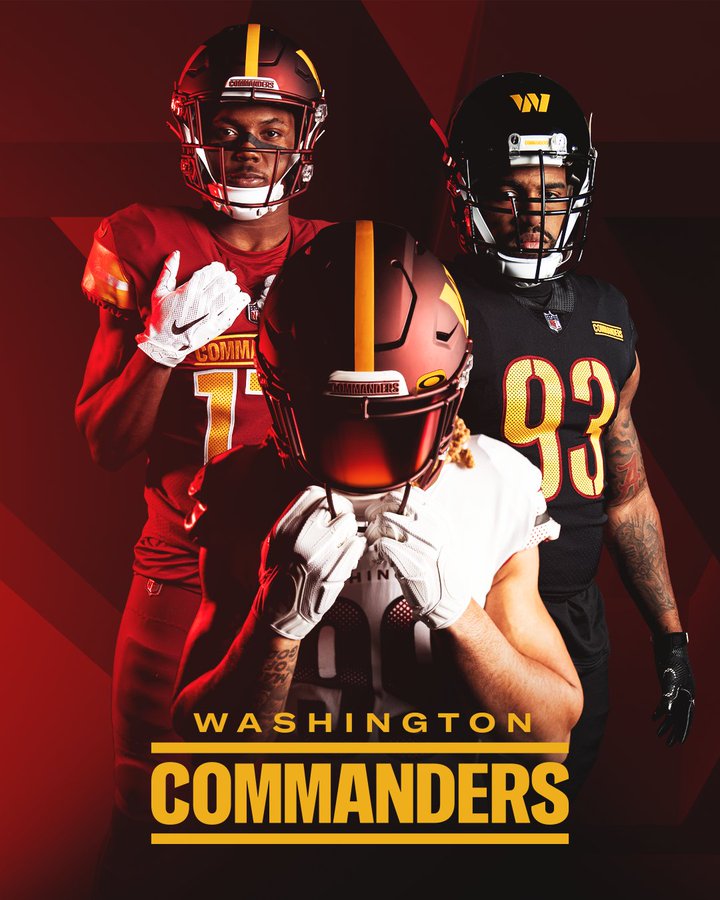
Washington Commanders


What's in a name? A lot.

After 87 years as the Redskins and 2 years as the Washington Football Team, the franchise announced today that its new name would be the Commanders.

The Redskins name which has offended Native American Indian tribes for many decades has been the subject of discussions for years without any movement. But that changed in mid-2020 when a letter signed by 87 investors and shareholders with a total worth of $620 billion was sent to sponsors FedEx, PepsiCo and Nike, asking them to stop doing business with the team unless its name was changed. 

There had been some fan input and one popular name among fans, RedWolves, was dropped because of trademarks held by others. Other names under consideration included Presidents, Brigade, Redhogs, Football Team, Armada, and Defenders.

The renaming process itself took 18 months and two full NFL seasons. 

Their new Twitter account is @Commanders

01 February 2022

Fare Well and Farewell


You have probably said "Farewell" to someone as they left for somewhere else. Maybe, they were heading to their home a few blocks away. Maybe, they were about to board a plane or boat for a more distant journey. 

The modern "farewell" originates in Middle English farewel, an expression, possibly further derived from Old English far wel. The verb fare means to travel or journey. Wishing someone "Fare well!" was a kind of blessing to travel safely and well.

Today's "farewell" can often just mean "goodbye" but in its earliest usage (first evidence of the word dates back to 1325–75) it was used to wish someone the best on a significant journey ahead.

Fare thee well, sailor!

Fare Thee Well was a series of concerts with most of the surviving members
 of the Grateful Dead to celebrate the 50th anniversary of the band.


28 January 2022

The Left Banke

The Left Banke, 1965 in a photo from KRLA Beat, a newspaper published
for KRLA Radio in the mid-1960s., Public Domain, Link

The Left Banke was an American rock band formed in New York City in 1965. They are best known for their two songs "Walk Away Renée" and "Pretty Ballerina."

Due to keyboardist Michael Brown's classical background, they had a sound that was labeled by critics as "baroque rock," or "Bach rock." Not all their songs featured string arrangements and classical-sounding piano and harpsichord, but enough did that the labels stuck. Their vocal harmonies were reminiscent of the "British invasion" bands like the Beatles and the Zombies.

The original lineup was keyboards/composer Michael Brown, drummer/singer George Cameron, bass guitarist/singer Tom Finn, lead singer Steve Martin and drummer Warren David-Schierhorst. It was Brown's father, Harry Lookofsky, who got them into a recording studio. Harry was a well-known session violinist and ran a studio in New York. He ended up as their initial producer, manager and publisher.

"Left Bank" is the Anglicized version of the French Rive Gauche which is the southern bank of the river Seine in Paris. The river cuts the city into two parts and if you're looking downstream, the southern bank is to the left, and the northern bank (or Rive Droite) is to the right. The appeal to the band of the name Left Bank is its association with writers and artists, particularly after WWI. The area was known as the haunt of Colette, Djuna Barnes, Erik Satie, Hilda Doolittle (H.D.), Anaïs Nin, Gertrude Stein, Alice B. Toklas, Edith Wharton, Pablo Picasso, Arthur Rimbaud, Paul Verlaine, Henri Matisse, Jean-Paul Sartre, and the "Lost Generation" of American expatriates such as Ernest Hemingway, F. Scott Fitzgerald, and James Baldwin. The Left Bank became a phrase associated with bohemianism, counterculture, and creativity. The band added an "e" which is not French. (The French form of bank is banque.)

"Walk Away Renee" was a huge hit in late 1966 and their second single, "Pretty Ballerina", (both written by Brown) charted in early 1967. They appeared on The Left Banke album Walk Away Renee/Pretty Ballerina. Rolling Stone magazine put "Walk Away Renée" at number 220 in its list of "The 500 Greatest Songs of All Time."

The band went through personnel issues and broke up, reformed, and recorded with other members.  The songs recorded by various incarnations of the group in 1967 and 1968 were assembled into a second LP, The Left Banke Too, which was released in November 1968.

The single from the second album that is most like the original "baroque" sound of the first two singles is "Desiree."


The band's story gets complicated at this point. Here's a capsule summary. The band continued playing live in 1969, but without Steve Martin. They disband but Brown and Martin reunite in the studio to record another single as The Left Banke, "Myrah" b/w "Pedestal." Brown, Cameron, Finn and Martin reunite to record two songs for the movie Hot Parts but due to legal issues with the name "Love Songs in the Night" and "Two by Two" are released as being by Steve Martin solo recordings.

There are a number of odd one-off recordings, some of which have been collected on other albums or passed along bootleg style. One of those came out of a 1971 recording session at Bell Records with Les Fradkind. "I Could Make It Last Forever" (not written by any band members) was released on Fradkin's Goin' Back solo CD in 2006 and features Caro, Finn, Cameron and Brown and Brown's father, violinist Harry Lookofsky. 

Martin, Cameron and Finn reunited as The Left Banke in 1978 to record an album's worth of songs but an album was not released. One single, "Queen of Paradise" (b/w "And One Day"), was released in late 1978 with some airplay. The album was issued by Relix Records in 1986 under the title Strangers on a Train (Voices Calling in Europe) but gained little attention or sales.

For fans, several of Michael Brown's post-Banke bands are collectible. Those bands include Montage, Stories, and The Beckies.

The 1992 Mercury Records compilation, There's Gonna Be a Storm: The Complete Recordings 1966–1969 collected almost all of their recorded output from those years.

None of the band members are still alive.

For more details see the band's Wikipedia entry and check out the fine video history below.


12 January 2022

COVID-19 variant names

SARS-CoV-2

As I write this, the omicron variant of the Covid (Sars-CoV-2) is peaking in the U.S., but no one believes it will be the last variant of this deadly disease. But why "omicron"? 

The World Health Organization (WHO) decided in May 2021 that its nomenclature for important strains in the Sars-CoV-2 variant classification would adopt Greek-letter names. WE use those letters to label hurricanes and tropical storms after we run out of the letters in our own English alphabet - which happened this past season. 

I found an article from the WHO titled "WHO announces simple, easy-to-say labels for SARS-CoV-2 Variants of Interest and Concern." But this naming is not so simple or easy to say.

The switch to Greek for names was to end associating place-of-origin names (“Wuhan virus,” “South African variant”) which was criticized as being xenophobic and racist. They didn't want to put the blame on a country or region.

The other place that some people learn the Greek alphabet is in the naming of fraternities and sororities. So many of us have learned some of the letters.

The letters of the Greek alphabet are alpha, beta, gamma, delta, epsilon, zeta, eta, theta, iota, kappa, lambda, mu, nu, xi, omicron, pi, rho, sigma, tau, upsilon, phi, chi, psi, omega.

Wait - how did we jump from the delta variant all the way to omicron?

It turns out that when what we call the omicron variant appeared, the WHO had already used up 12 of the Greek alphabet’s letters. These “variants of interest” thankfully didn't develop enough to hit the general public and the media. Next should have been "Nu." You see a problem with that letter. How do we differentiate a "Nu variant" from a "new variant"?

That makes sense. So, next is "Xi."  Nope. That one looks like a common Chinese family name. I'm sure Chinese President Xi Jinping and many others are happy to not have a variant with their name. 

There is also the issue of pronunciation with the Greek letters. For example, "xi" is pronounced in Greek as "zy" (like xylophone) and it is usually transliterated in English as  "she." 

I would assume that the next variant would be "Pi" but I read something today that said next will be "Omega" which is the big "O" compared to small "o" omicron. That sounds ominous. And what happened to pi, rho, sigma, tau, upsilon, phi, chi, and psi?

When the Delta variant hit hard last summer, Delta Air Lines was not very happy. I actually saw a witty tweet response from the airline's own chief health officer, Dr. Henry Ting: "We prefer to call it the B.1.617.2 variant since that is so much more simple to say and remember.”

Going back to when all this started, why was it COVID-19? The illness caused by the SARS-CoV-2 was given the acronym COVID-19 by the WHO to represent "coronavirus disease 2019." The "19" for the year, not because it was the 19th version of it. This name was also chosen to avoid stigmatizing any populations, geography, or animal (like a bird or swine flu) associations that had occurred in the past and still happen occasionally.

SARS-CoV-2 is the acronym + abbreviation used to label “severe acute respiratory syndrome coronavirus 2” which was given in February 2020. This name was chosen because the virus is genetically related to the coronavirus responsible for the SARS outbreak of 2003. While related, the two viruses are different.