I had to look up the word "cisgender" today when I saw it used in an article: "No cisgendered male can express opinions about that topic."
Cisgender (which is sometimes abbreviated to "cis") is a term to describe people whose gender identity matches the sex that they were assigned at birth.
The Latin-derived prefix cis-, means "on this side of" and can be considered the opposite of trans-, which means "on the other side of."
For example, you can say transatlantic to mean on the other side of that ocean, as in a "transatlantic ship crossing," or say "cisatlantic" to mean on this side of the Atlantic Ocean.
Despite my ignorance of the word, it has been around for awhile. German sexologist Volkmar Sigusch used the neologism cissexual (zissexuell in German) in his 1991 article "Die Transsexuellen und unser nosomorpher Blick" ("Transsexuals and our nosomorphic view") as the origin of the term.
Cisgender is a word that applies to the vast majority of people who are not transgender. Is there a need for such a word? The best parallel in our language would be homosexual and heterosexual.
You can go deeper into the sociology of this in gender studies and I suspect the word will be in wider usage in the future. There are already derivatives of the terms cisgender and cissexual include "cis male" for "male assigned male at birth", "cis female" for "female assigned female at birth" (analogously cis man and cis woman) and also cissexism and cissexual. A related adjective is "gender-normative" because "cisgendered" is used instead of the more popular "gender normative" to refer to people who "do not identify with a gender diverse experience, without enforcing existence of a normative gender expression *."
I also didn't realize that back in 2014 Facebook began offering "custom" gender options, allowing users to identify with one or more gender-related terms from a selected list, including cis, cisgender, and others.
05 December 2018

15 November 2018
Obelism
Obelism is the practice of annotating manuscripts with marks set in the margins. Modern obelisms are used by editors when proofreading a manuscript or typescript.
One example is the "stet." Stet is is Latin for "Let it stand," and it is used by editors or authors to mean "disregard the previous mark." Another obelism is "dele" for delete.
The word "obelus/obelos" and the symbol comes from ὀβελός, the Ancient Greek word for a sharpened stick, spit, or pointed pillar. This is the same root as that of the word "obelisk."
An obelos was placed by editors on the margins of manuscripts going all the way back to the ancient writings of Homer. They would indicate lines that were doubtfully Homer's.
One example is the "stet." Stet is is Latin for "Let it stand," and it is used by editors or authors to mean "disregard the previous mark." Another obelism is "dele" for delete.
The word "obelus/obelos" and the symbol comes from ὀβελός, the Ancient Greek word for a sharpened stick, spit, or pointed pillar. This is the same root as that of the word "obelisk."
An obelos was placed by editors on the margins of manuscripts going all the way back to the ancient writings of Homer. They would indicate lines that were doubtfully Homer's.
 |
| Three basic variants of dotted obelos glyphs |
08 November 2018
Tsunami
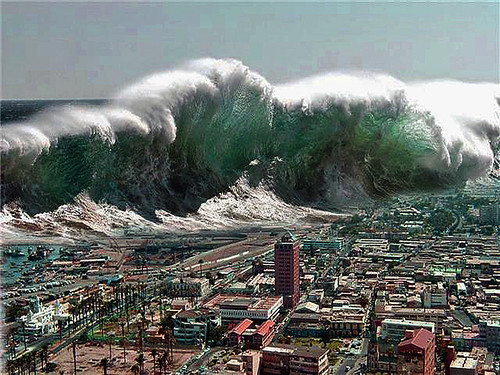
The word tsunami unfortunately turns up in the news regularly as this devastating effect of earthquakes is not uncommon. It is particularly common particularly in the Pacific Islands and coasts. An earthquake far out in the ocean is capable of creating enough vibration to displace massive amounts of seawater and send deadly waves at islands and coastlines.
It should not be surprising that the term comes from the Pacific islands of Japanese. Two words are combined: TSU (pronounced sue) which means "harbor" and NAMI (nah me) which means "wave." The word distinguishes other words to describe waves as a very large one that enter a normally safe harbor.
 |
| Katsushika Hokusai: The Great Wave off Kanagawa (Kanagawa oki nami ura) The waves in this work are sometimes mistakenly referred to as tsunami (津波), but they are more accurately called okinami (沖波), great off-shore waves. |
Subscribe to:
Posts (Atom)