28 July 2023

Naming the Clouds

I came across a book that looks at a story from modern meteorology about an overlooked man, Luke Howard. The Invention of Clouds is a detailed and informative examination of Howard's life and achievements. What did Howard do? He named the clouds, classifying them in terms that remain familiar to this day: cirrus, stratus, cumulus, and nimbus. 

A shy young Quaker who was an amateur meteorologist, Luke Howard, defined what had hitherto been random and unknowable structures ― clouds.

In December 1802, Luke Howard delivered a lecture that was to be a defining point in natural history and meteorology. His cirrus, stratus, cumulus, and nimbus were a new and precise nomenclature that sparked worldwide interest and captured the imaginations of some of the century's greatest figures in the fields of art, literature, and science. Goethe, Constable, and Coleridge were among those who came to revere Howard's vision of an aerial landscape. Legitimized by the elevation of this new classification and nomenclature, meteorology fast became a respectable science.
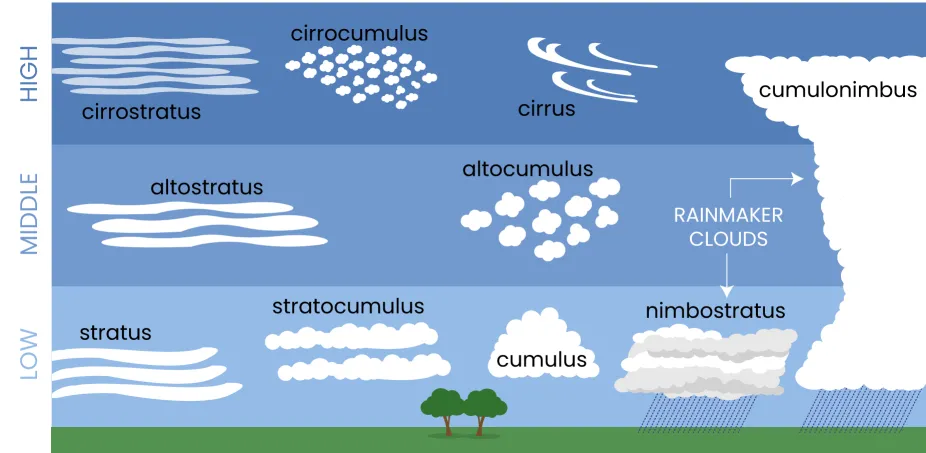

Most clouds can be divided into groups (high/middle/low) based on the height of the cloud's base above the Earth's surface. Other clouds are grouped not by their height, but by their unique characteristics, such as those that form over mountains (lenticular clouds) or beneath existing clouds (mammatus clouds).

Clouds seen from above give you a different perspective


24 July 2023

Charon


Charon (KAIR-on, or SHAIR-ən) is the largest of the five known natural satellites of the dwarf planet Pluto. It was only discovered in 1978 at the United States Naval Observatory in Washington, D.C. by astronomer James Christy. After its discovery, Charon was first given the temporary designation S/1978 P 1, following the then recently instituted convention.

Christy soon after suggested the name Charon as a scientific-sounding version of his wife Charlene's nickname, "Char". His colleagues at the Naval Observatory proposed Persephone, since mythological characters are often used in naming stars, planets, and moons. Christy decided to use Charon because he discovered in an interesting bit of serendipity that it is also the name of an appropriate mythological figure. Charon is the mythological Greek ferryman of the dead, closely associated with the god Pluto. The IAU officially adopted the name in late 1985, and it was announced on January 3, 1986.

But I find it even more interesting and serendipitous that in 1940 science fiction author Edmond Hamilton invented three moons of Pluto for his novel Calling Captain Future. He named them Charon, Styx, and Cerberus after mythological characters. He thought he was writing about fictional moons, though one might suspect that a planet (back then Pluto had full planet status) would have at least one moon. Pluto has five known moons. Charon, the largest, followed by Styx; Nix; Kerberos; and Hydra. Hamilton seems to have predicted 2 of the 5 correctly.

In Greek mythology, Charon or Kharon is the ferryman of Hades, the Greek underworld. He carries the souls of those who have been given funeral rites across the rivers Acheron and Styx, which separate the worlds of the living and the dead.


Charon as depicted by Michelangelo
 in his fresco The Last Judgment in the Sistine Chapel

Archaeology confirms that, in some burials, low-value coins were placed in, on, or near the mouth of the deceased, or next to the cremation urn containing their ashes. This has been taken to confirm that at least some aspects of Charon's story are reflected in some Greek and Roman funeral practices. In Virgil's epic poem, Aeneid, the dead who could not pay the fee, and those who had received no funeral rites, had to wander the near shores of the Styx for one hundred years before they could cross the river.

17 July 2023

avenue, street, lane

An avenue does not have to be intended for vehicles,
such as this avenue at Alexandra Park, London


Avenue and street are such common words that you might think their meaning and origin would be obvious. 

An avenue is defined as a broad road in a town or city, typically having trees at regular intervals along its sides. "The beautiful tree-lined avenues that lead to the city park."

In the early 17th century, the word comes from the French, feminine past participle of avenir ‘arrive, approach’, from Latin advenire, from ad- ‘towards’ + venire ‘come’. 

Though it is not always the case now, once an avenue led to something in particular. Today, most people would probably define an avenue as "a big street."

Avenue can also be more figurative and mean a way of approaching a problem or making progress toward something, which clearly is similar to the literal roadway. "the scientists are exploring three promising avenues of research into a cure for the disease."

In prehistoric archaeology, an avenue is a long, parallel-sided strip of land, measuring up to about 30m in width, open at either end, with edges marked by stone or timber alignments and/or a low earth bank and ditch. These avenues are thought to have been ceremonial or processional paths and to be of early Bronze Age date. They seem to have been used to indicate the intended route of approach to a particular monument. Examples in Britain include Stonehenge Avenue, and Beckhampton Avenue and West Kennet Avenue at Avebury. An example in Ireland is the avenue going up the Hill of Tara.

A street is defined as a public road in a city or town, typically with houses and buildings on one or both sides.

The Old English strǣt, of West Germanic origin, from late Latin strāta (via) ‘paved (way)’, the feminine past participle of sternere ‘lay down’.

You have probably been on a smaller street that was called a "lane." A lane is defined as part of a roadway that is designated to be used by a single line of vehicles to control and guide drivers and reduce traffic conflicts. Most public roads - streets and avenues - have at least two lanes, one for traffic in each direction, sometimes separated by lane markings. 

besides being a quaint little roadway, a lane can also be designated for a special purpose, such as for bicycles, buses or emergency vehicles.

Ambulance lane.jpg
Image: CC0, Link