What does that mean and where did this odd expression originate?
This slang term has been in use since the early 19th century. The origin is disputed, but the most common origin story is that it comes from an old children's game called dibstones.
 Dibstones is a child's game, similar to jacks and dice games. A dibstone is a pebble used in the game as a counter. The pebbles or the discarded knucklebones of sheep have been used since the late 17th century.
The game is from England, but the slang usage seems to be American. While playing, you can place a stone at your place to indicate a point. Similar to the modern slang usage, this means you have claimed a point.
To "call dibs" today is to claim a temporary right to something or to reserve it.
The more common game of Jacks is also known as Knucklebones, Tali, or Fivestones. The games all have origins going back to ancient Greece and are mentioned by Sophocles and in the Iliad and Odyssey.
The games are usually played with five small objects (ten in the case of jacks). At one time, the game pieces were literally knucklebones, which are the astragalus bone in the ankle, or the hock of sheep. The jacks are thrown up and caught along with a ball or other object.
Modern jacks have six points/knobs and are usually made of metal or plastic. The simplest throw consists of either tossing up one jack, or bouncing a ball, and picking up one or more jacks/pebbles/knucklebones from the ground while it is in the air.
The games have a whole series of throws with odd names such as "riding the elephant", "peas in the pod", "horses in the stable", and "frogs in the well".
A variant on the previously mentioned games that is played by Israeli school-age children is known as kugelach or Chamesh Avanim ("five rocks"). Instead of jacks and a rubber ball, five die-sized metal cubes are used. The game cube is tossed in the air rather than bounced.
This slang term has been in use since the early 19th century. The origin is disputed, but the most common origin story is that it comes from an old children's game called dibstones.
Dibstones is a child's game, similar to jacks and dice games. A dibstone is a pebble used in the game as a counter. The pebbles or the discarded knucklebones of sheep have been used since the late 17th century.The game is from England, but the slang usage seems to be American. While playing, you can place a stone at your place to indicate a point. Similar to the modern slang usage, this means you have claimed a point.
To "call dibs" today is to claim a temporary right to something or to reserve it.
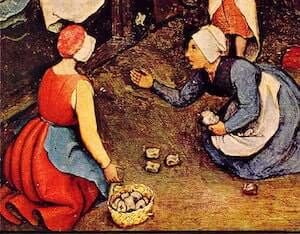 |
| Pieter Bruegel the Elder - Children's Games - Knucklebones |
The more common game of Jacks is also known as Knucklebones, Tali, or Fivestones. The games all have origins going back to ancient Greece and are mentioned by Sophocles and in the Iliad and Odyssey.
The games are usually played with five small objects (ten in the case of jacks). At one time, the game pieces were literally knucklebones, which are the astragalus bone in the ankle, or the hock of sheep. The jacks are thrown up and caught along with a ball or other object.
Modern jacks have six points/knobs and are usually made of metal or plastic. The simplest throw consists of either tossing up one jack, or bouncing a ball, and picking up one or more jacks/pebbles/knucklebones from the ground while it is in the air.
The games have a whole series of throws with odd names such as "riding the elephant", "peas in the pod", "horses in the stable", and "frogs in the well".
 |
| Sheep knucklebones used in the game |
A variant on the previously mentioned games that is played by Israeli school-age children is known as kugelach or Chamesh Avanim ("five rocks"). Instead of jacks and a rubber ball, five die-sized metal cubes are used. The game cube is tossed in the air rather than bounced.
here's also the Korean game Gonggi, another variant.
I was not able to find the origin and reason why the game or the game pieces are called "jacks." Do any readers know?
I was not able to find the origin and reason why the game or the game pieces are called "jacks." Do any readers know?