A female dominant with a male submissive at her feet, from Dresseuses d'Hommes (1931) by Belgian artist Luc Lafnet
These two words are eponyms.
Masochism means to derive satisfaction from another’s pain. Chevalier Leopold von Sacher-Masoch was a 19-century Austrian journalist and writer. In 1869 he persuaded his mistress to serve as a slave for him for 6 months.
He then used the experience to write the novella Venus in Furs. The novella described the degradation of the main character.
It was so influential that in 1886, esteemed Austrian psychiatrist Richard Freiherr von Krafft-Ebing coined the term ‘masochism’ to depict satisfaction from another’s pain.============
Sadism, or more properly sadomasochism, is the giving and receiving of pleasure from acts involving the receipt or infliction of pain or humiliation.
Practitioners of sadomasochism may seek sexual pleasure from their acts. The terms sadist and masochist refer respectively to one who enjoys giving and receiving pain.
The abbreviation S&M is commonly used for Sadomasochism (or Sadism & Masochism), although the initialisms S-M, SM, or S/M are also used, particularly by practitioners. Sadomasochism is not considered a clinical paraphilia unless such practices lead to clinically significant distress or impairment for a diagnosis. Similarly, sexual sadism within the context of mutual consent, generally known under the heading BDSM, is distinguished from non-consensual acts of sexual violence or aggression.
The term "sadism" has its origin in the name of the Marquis de Sade (1740–1814), who not only practiced sexual sadism but also wrote novels about these practices, of which the best known isJustine.
I have always heard the phrase "a Horatio Alger story" and took it to mean that this Horatio person had a rags-to-riches success story. The phrase is not in very common usage today and it turns out that my definition is not completely accurate to its origin.
There was a real Horatio Alger Jr. who was born in Chelsea, Massachusetts in 1832. He was the oldest of five kids, and he was nearsighted and asthmatic. He was accepted to Harvard when he was 16, and he said, "No period of my life has been one of such unmixed happiness as the four years which have been spent within college walls."
He studied under Henry Wadsworth Longfellow, was named Class Poet, and wrote essays, poetry, and short sketches. After graduation, he didn't enjoy much publishing success, so he made his living by taking a series of temporary teaching jobs.
He moved to New York City and began working with homeless and delinquent boys, establishing boarding houses and securing homes and public assistance for them. It was during this time that he started writing dime novels for boys. It was his fourth book Ragged Dick; or, Street Life in New York with the Boot-Blacks(1868) that finally made him a literary success.
The book followed a formula that he would return to often - a young boy, living in poverty, manages to find success and happiness by working hard and never giving up. The books created a kind of American concept that if you worked hard, and lived virtuously, and had a combination of "pluck and luck," you could go from the gutter to the mansion.
The popularity of the books - and maybe that idea - decreased as the century turned. He revised his style, making the stories more violent and gritty, but they had peaked.
He died in near-poverty in 1899. So his story is more of a riches-to-rags story.
BabyCenter parents share their baby's name, so the website doesn't predict the top names but just gives a live look at trends. If you are reading this in the second half of 2023 or later, the 2023 list I mention here is probably different by year's end.
Olivia and Liam were the most popular baby names of 2021 and 2022. In fact, the top five baby girl names all remained the same in 2021 and 2022. Here's an oddity - look at how many girls' names end in "a."
BabyCenter is kind of unique as they track names in real-time so the list is always being updated. We are halfway into 2023 and it looks like Liam who has held that top spot for boys since 2019 has dropped and Oliver and Noah are battling it out for the top.
BabyCenter is a digital parenting resource and this year's list changes as parents share what names they’ve chosen for their newest additions.
When I wrote this post in 2010, it was about popular baby names at that time and particularly the effect of the Twilight movie series on baby names. What I didn't expect was how popular the post would be over the years - and that it would create another "Twilight effect."
When a post gets a lot of hits/visits, it moves up in my site's rankings and also in the way search engines rank pages. That attracts visitors and it also attracts spammers. (Hello India!) This post (in its original 2010 form) got more spam comments than any other post. It is not the most popular post here but it is the most popular with spammers who want to leave a comment with links to their sites or services. I took down the post for a few weeks and made some changes to the post and title in 2021but it still had the "twilight spam effect."
Looking back at the top baby names in 2009 shows that Moms and Dads were looking to popular vampire books and the first family for baby names. Fame can be fleeting - Miley (Cyrus) and Jonas (as in the brothers) took a stock market dive at the end of 2009.
Isabella was the top baby name for girls, Jacob for boys. Isabella’s climb to the top in 2009 ended Emma’s one-year reign. Jacob is on an 11-year run at the top. The surname of the Twilight movie series vampire Edward Cullen became the fastest-rising baby boy name in 2009.
Barack didn’t crack the top 1,000 for boys in 2010, but a version of President Obama's daughter’s name, Malia, was the fastest riser for girls. Maliyah moved up 342 spots, to No. 296, while Malia came in at No. 192, rising 153 spots.
Updating to now, we find these are the top U.S. names currently as supplied by the Social Security Administration from when parents were getting their baby a SS number so they could create all their official paperwork.
Here are some other sources if you are looking for baby names.
An adage is a short, memorable, usually philosophical saying. These kinds of saying go by any number of other names, and though there are probably distinctions, they seem pretty similar to me. For example, aphorisms, proverbs and bywords are close synonyms.
I did find that an adage that describes a general moral rule is usually called a "maxim". An aphorism seems to be more of an expression that seems "deep" and may not be widely used. But, one that is witty or ironic seems to get the tag "epigram".
Many adages are ancient and if they have been overused, they may be referred to nowadays as a "cliché", "truism", or "old saw."
Some more modern adages get labeled as "laws" or "principles," such as Murphy's Law.
The word "aphorisms" comes from a book by that name by Hippocrates that is a series of propositions concerning the symptoms and diagnosis of disease and the art of healing and medicine. The first line is "Life is short, art long, opportunity fleeting, experience deceptive, judgment difficult."
I found many lists of adages online that are very common, such as "Don't count your chickens before they hatch" and "Don't burn your bridges."
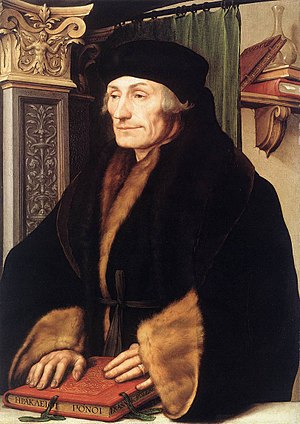
Erasmus, the compiler - by Hans Holbein
I was surprised to find how many adages come to us from the Dutch humanist Desiderius Erasmus Roterodamus, commonly known as simply Erasmus. He didn't create these. He compiled them. He published several volumes with the final edition of Adagia (1536) having more than 4,000. Most of them are annotated Greek and Latin proverbs that he compiled.
Here's a sampler of ones (translated to English) that you are likely to recognize:
More haste, less speed The blind leading the blind A rolling stone gathers no moss One man's meat is another man's poison Necessity is the mother of invention One step at a time To be in the same boat To lead one by the nose A rare bird Even a child can see it To have one foot in Charon's boat (To have one foot in the grave) To walk on tiptoe One to one Out of tune A point in time I gave as bad as I got (I gave as good as I got) To call a spade a spade Hatched from the same egg Up to both ears (Up to his eyeballs) As though in a mirror Think before you start What's done cannot be undone Many parasangs ahead (Miles ahead) We cannot all do everything Many hands make light work A living corpse Where there's life, there's hope To cut to the quick Time reveals all things Golden handcuffs Crocodile tears To lift a finger You have touched the issue with a needle-point (To have nailed it) To walk the tightrope Time tempers grief (Time heals all wounds) With a fair wind To dangle the bait Kill two birds with one stone To swallow the hook The bowels of the earth Happy in one's own skin Hanging by a thread The dog is worthy of his dinner To weigh anchor To grind one's teeth Nowhere near the mark To throw cold water on Complete the circle In the land of the blind, the one-eyed man is king No sooner said than done Neither with bad things nor without them (Women: can't live with 'em, can't live without 'em) Between a stone and a shrine (Between a rock and a hard place) Like teaching an old man a new language (Can't teach an old dog new tricks) A necessary evil There's many a slip 'twixt the cup and the lip To squeeze water out of a stone To leave no stone unturned Let the cobbler stick to his last (Stick to your knitting)
God helps those who help themselves
The grass is greener over the fence The cart before the horse Dog in the manger One swallow doesn't make a summer His heart was in his boots To sleep on it To break the ice Ship-shape To die of laughing To have an iron in the fire To look a gift horse in the mouth Neither fish nor flesh Like father, like son


 and founder of