Showing posts with label animals. Show all posts

03 July 2026

Sweating Like a Pig and Pig Iron


Pigs have given English several porcine-related phrases based on their perceived behaviors. Some make sense, such as “pigging out” or “happy as a pig in mud.” 

Pigs also have a reputation for excessive perspiration, given the popularity of the phrase “I’m sweating like a pig!” However, this seems to be just bad press. While swine do have some sweat glands, as all mammals do, they have relatively few for their size. As such, they have to roll in the mud or do another similar activity to cool their bodies on a hot day. So, where did “sweating like a pig” come from? 

The idiom actually has to do not with the animal but with the process of iron smelting. More specifically, it comes from the term “pig iron.” 

“Pig iron,” going back to 1665, refers to the “crude iron that is the direct product of the blast furnace.” It’s known as “pig iron” because of the way iron used to be cast. Hot iron was poured into sand molds in a way that visually resembled tiny piglets suckling at their mother’s teat. When the ingots cooled and were broken off, they were sometimes referred to as “pigs,” hence the term “pig iron.” 

As for the “sweating” element of the phrase, it has to do with the cooling process. As iron cools, the surrounding air begins to hit its dew point. In turn, this causes moisture to form on the iron, which looks like little droplets of sweat beading down the ingots (the pigs), and this is where we get “sweat like a pig.”


20 January 2016

Collective Nouns for Birds

You know about a herd of deer and a pack of dogs or coyotes, but what about a herd of cranes?

A list of English terms of venery (an archaic word for hunting) came about in the Late Middle Ages and these included somewhat whimsical collective names for animals.

One source of these terms was the Book of Saint Albans (or Boke of Seynt Albans), a 1486 book, a compilation of matters relating to the interests of the time of a gentleman. It was the last of eight books printed by the St Albans Press in England, and it is also known by the more accurate name, The Book of Hawking, Hunting, and Blasing of Arms. It contains three essays, on hawking, hunting, and heraldry.

Although originally considered whimsical and humorous, many of these terms for have become part of the modern-day lexicon and some common collective terms (such as herd and flock) for some animals.

Many of the collective nouns for birds are the most poetic.
  • gulp of cormorants
  • covert of coots 
  • murder of crows
  • cast, cauldron, or kettle of birds of prey, such as hawks and falcons
  • chain of bobolinks
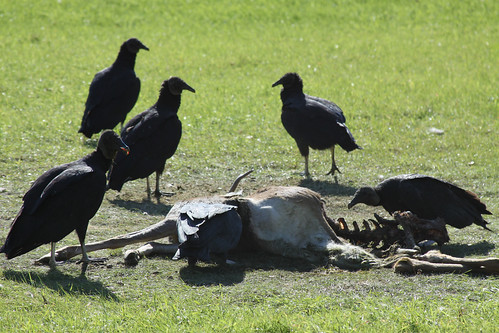
  • wake of buzzards
  • banditry of chickadees
  • convocation, congregation of eagles
  • charm of finches
  • glittering, shimmer, tune, bouquet, hover of hummingbirds
  • party, scold of jays
  • bevy, exaltation, ascension of larks

Black Buzzards 4
a wake of buzzards