08 March 2021
Gin Blossoms
01 March 2021
Mad as a March Hare
![]() |
I connect the phrase to Lewis Carroll's Alice stories but its usage predates his books.
This British English phrase has been connected to a kind of "spring fever" craziness and also Love being "in the air." It appeared in John Heywood's collection of proverbs published in 1546.
In the excellent book, The Annotated Alice (my favorite edition), it is explained that it was a popular (and somewhat accurate) belief about rabbits/hares' behavior at the beginning of their breeding season. In Britain, it starts in February or March and runs until September. In the early days of that breeding season, males are "mad" and overly enthusiastic about getting on with things. Females sometimes have to repel those unwanted suitors with their forelegs. Apparently, this observation was once believed (incorrectly) to be two males fighting for breeding dominance.
The March Hare that Alice meets in Wonderland is sometimes confused with the Mad Hatter hare. The March Hare is called "Haigha" in Through the Looking-Glass and he is most remembered, especially from film versions, as part of tea party scene in Carroll's 1865 classic, Alice's Adventures in Wonderland.
Alice, knowing that it is not the month of March, thinks that perhaps "The March Hare will be much the most interesting, and perhaps as this is May it won't be raving mad – at least not so mad as it was in March."
The Mad Hatter is a friend of the March Hare.
![]() |
I like Sir John Tenniel's illustrations best. He shows the hare with some straw on his head, which was a common way to depict madness in Victorian times.
The March Hare later appears at the trial for the Knave of Hearts. His final appearance is as "Haigha." Lewis Carroll says the name is pronounced to rhyme with "mayor", which would make it "hare." Haigha is the personal messenger to the White King in Through the Looking-Glass and oddly Alice doesn't seem to recognize him as being the March Hare from his earlier appearance in her dream.
That can happen when you go through a looking glass or down a rabbit hole into Wonderland.
22 February 2021
jury rigging
![]() |
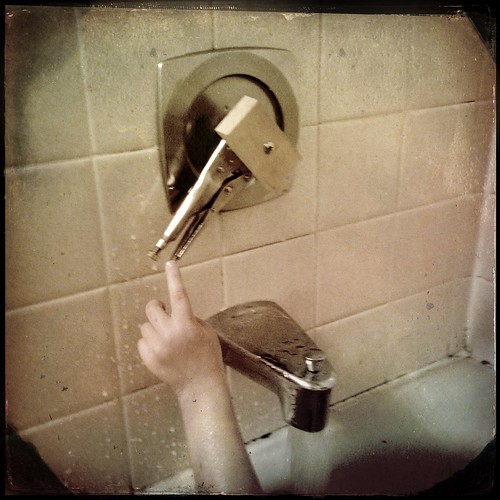
| an example of some jury-rigged plumbing |
A plumber working at my house recently said that he could "jury rig something until I get the parts I need." I know he meant that he could do a temporary fix, but then I wondered (as I often do here) about where the term originated.
It didn't seem to have any connection to the common use of jury as related to a courtroom trial. Is it about a lawyer trying to rig the member of a jury to work to his client's advantage? In fact, it doesn't have any connection to that use of jury.
Jury rigging (AKA "jerry rigging") is both a noun and a verb describing makeshift repairs made with only the tools and materials at hand.
Its origin comes from the world of boats and ships, particularly sail-powered ones. After a dismasting, a replacement mast, often referred to as a jury mast and some sail, would be fashioned so that the craft could continue on its journey. That explains the "rigging" part as it is the system of ropes, cables, or chains employed to support a ship's masts and to control or set the yards and sails.
But what about the "jury" part?
Using "jury" as an adjective, in the sense of makeshift or temporary, has been said to date from at least 1616. There are two parts to the origin of this usage. Part one is that this is a corruption of the French jour meaning "a day." Go back further to the Latin adjutare ("to aid") and the Old French ajurie ("help or relief").
So, my plumber (who likely did not know any French or Latin or has spent much time on ships) was saying that he could "give me some relief for the day."