09 October 2023

Boob, booby trap, boobs

Jeremy the Boob, the foolish Nowhere Man in The Beatles' Yellow Submarine


You are probably aware that the word “boob” can be used to describe a “stupid”, “foolish”, or otherwise “clumsy” person. This particular definition is generally thought to have derived from the Spanish word “bobo” which roughly means “dunce.” This Spanish word comes from the Latin “balbus” meaning “stammering" and there is a theory that “boob”, meaning “stupid”, has Gaelic origins.

In English, this meaning appears in the late sixteenth century. later, it was applied to birds of the Sula genus that seem foolish because of their very large feet that make them rather clumsy walkers. They would often land on ships, were easy to catch and sailors began to call them “boobies.”



Much later, other things had the term attached with a similar meaning: the “boob-tube” for stupid TV programming, a “booby trap” being a trap that a foolish person would fall for, and a "booby prize” being a prize for the "top loser."

But somewhere along the way, "boobs" as a noun became slang for women's breasts. This usage seems to have gone wide around 1929 as U.S. slang, but the term boobies for breasts appears in the later 17th century. It may have been derived from the Latin puppa, literally "little girl," though it may also have come from the French poupe ("teat") or the German dialectal bubbi which begat the English bubby.

"Bubby" is defined as a vulgar slang that goes back to 1675 and it may have just evolved into "booby" then to be shortened to "boob." 

An explanation that is almost definitely not true, but is amusing, is that the word itself is a visual representation of what a pair of breasts.
Viewed from above B
Viewed from the front oo 
Viewed from a side view b

In 2013, an Australian women’s clothing chain, Bonds, found in a survey that 74% of Australian women typically used the word “boobs” to refer to their own breasts. The company decided to use the word in their “Bonds for Boobs” ad campaign to advertise their bras and as a partnership with the National Breast Cancer Foundation.


05 October 2023

Fountains of Wayne

Fountains of Wayne is a Grammy-nominated American power pop band. The group was formed by songwriters Adam Schlesinger and Chris Collingwood. They met as freshmen at Williams College and began playing music together. After college, Collingwood formed the Mercy Buckets in Boston and Schlesinger formed Ivy in New York City, but they connected again in 1996 and formed Fountains of Wayne.

Chris and Adam -  Fountains of Wayne

Chris and Adam performing in New Jersey (2007)


The band name was taken from a garden and lawn ornament store in Wayne, New Jersey by that name. Adam Schlesinger grew up in nearby Montclair. The store can be seen in The Sopranos episode "Another Toothpick" but it closed in 2009.


The entrance to the kitschy Fountains of Wayne store in NJ (2007)

Their biggest hit single was "Stacy's Mom." The single was powered by a popular music video, directed by Chris Applebaum, about an adolescent boy's attempts to get closer to the mom of his girlfriend Stacy. The mom was played by model Rachel Hunter. The clever video includes allusions to the 1962 film Lolita and 1982's Fast Times at Ridgemont High.

Adam Schlesinger says "Stacy's Mom" was a tribute to a band they liked, The Cars. The Cars' song "My Best Friend's Girl" has a similar instrumental intro. Cars frontman Ric Ocasek thought that the intro was a sample from his song "Just What I Needed" but the band says they performed it in the studio. Ocasek was asked to be in the video for the song but declined. (Wikipedia)

The band stopped recording but toured for a while after the album Sky Full of Holes.

Collingwood recorded an album as the singer/guitarist in Look Park

Schlesinger went on to record with Tinted Windows. This "supergroup" was formed by guitarist James Iha of The Smashing Pumpkins, singer Taylor Hanson of Hanson, Bun E. Carlos of Cheap Trick and Schlesinger. Adam also wrote many songs for other artists and for TV, Broadway and movies. Adam Schlesinger died of complications due to the COVID-19 virus in April 2020.

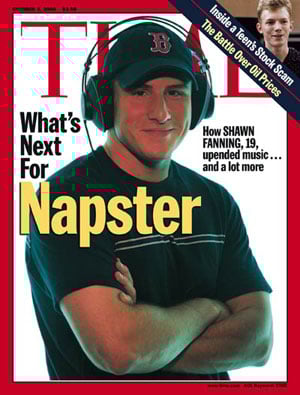
Napster


Napster was a file-sharing service founded by Shawn Fanning and Sean Parker that operated between June 1999 and July 2001. 

It was an innovative project by Fanning to create an independent peer-to-peer file-sharing service. When launched it allowed people to easily share their MP3 files (music) with other participants. It was followed by many other decentralized projects that used Napster's P2P file-sharing example, such as Gnutella, Freenet, BearShare, Soulseek, AudioGalaxy, LimeWire, Scour, Kazaa, and Grokster.

The idea of file-sharing from a decentralized, multi-user locations was a new and important piece of technology.

Napster and other services were shut down by court order for copyright infringement after strong legal actions against them from the record industry.


But why was it called Napster? Shawn Fanning joined a hacker chat to share his ideas and used the handle Napster. That was a name given to him by a junior high school basketball rival because of his nappy hair. In that hacker group, he connected with Parker and they started on the file-sharing network which would be given the nickname.

The reuse of the name has a complicated history. According to Wikipedia, as of this posting:
"Napster's brand and logos were acquired at a bankruptcy auction by Roxio which used them to re-brand the Pressplay music service as Napster 2.0. In September 2008, Napster was purchased by US electronics retailer Best Buy for $121 million. On December 1, 2011, pursuant to a deal with Best Buy, Napster merged with Rhapsody, with Best Buy receiving a minority stake in Rhapsody. On July 14, 2016, Rhapsody phased out the Rhapsody brand in favor of Napster and has since branded its service internationally as Napster and expanded toward other markets by providing music on-demand as a service to other brands like the iHeartRadio app and their All Access music subscription service that provides subscribers with an on-demand music experience as well as premium radio. On August 25, 2020, Napster was sold to virtual reality concert company MelodyVR. On May 10, 2022, Napster was sold to Hivemind and Algorand. The investor consortium also includes ATC Management, BH Digital, G20 Ventures, SkyBridge, RSE Ventures, Arrington Capital, Borderless Capital, and others."