There are some informal (slang) names for U.S. paper currency. One fairly common term is "bucks." It likely originated from the early American practice of trading deerskins, known as buckskins, which were used as a unit of exchange. Over time, the term "buck" became a colloquialism for money. It's thought that this term was later applied to dollars and paper currency, becoming a widely used slang term.
The term "clams" for money likely originated in the mid-19th century in the United States. One theory is that it came from the expression "shell out," meaning to pay up or cough up money, which references the practice of using seashells, like clamshells, as currency or for decoration in some cultures. This term may have been shortened to "clams" as a slang term for money.
The term "dead presidents" likely originated in the late 19th or early 20th century, as many U.S. presidents were featured on various denominations of currency. The term gained popularity over time, particularly in the mid-20th century, as it became a common slang term to refer to paper money. It's worth noting that not all U.S. currency features presidents, but the term "dead presidents" stuck due to the prominent portraits of presidents like George Washington, Abraham Lincoln, and others on various denominations.
As with the previous terms, we have "likely" rather than definitive origin stories. The term "dough" for money likely originated from the idea that money is a vital resource, much like dough is a fundamental ingredient for bread. It's a basic necessity that helps things "rise" or progress. In the late 19th and early 20th centuries in the United States, "dough" became a popular slang term for money.
The term "scratch" for money probably comes from the idea of scratching out a living or making ends meet. It may also come from the notion of scratching together enough money to achieve something. In a street-level context, it might imply that it's a resource that's earned or scrounged up through effort. The term is often used in phrases like "scratch together" or "from scratch," emphasizing the idea of gathering or accumulating resources.
"Greenbacks" became a semi-official name for some currency in 1861when the Union introduced Demand Notes to fund the Civil War. United States Notes followed in 1862. Both were dubbed "greenbacks" due to their distinctive green ink, an anti-counterfeiting measure.
As the first widespread US paper currency, these notes shared some similarities with today's bills, like the green color, but had notable design differences. Early $1 notes featured Treasury Secretary Salmon P. Chase and President Abraham Lincoln was on the $10 note. The backs showcased intricate wording or patterns, such as the crisscross sawhorse design.
Initially, greenbacks were printed in larger sizes - 7 3/8 x 3 1/8 inches - until they were downsized to 6 1/8 x 2 5/8 inches in 1929.


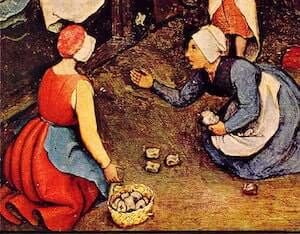
 Dibstones is a child's game, similar to jacks and dice games. A dibstone is a pebble used in the game as a counter. The pebbles or the discarded knucklebones of sheep have been used since the late 17th century.