29 October 2018

Boston Red Sox


The name Red Sox was chosen by owner John I. Taylor after the 1907 season. It is a reference to the red socks (hose) in the team's uniform which began in 1908.

There is a tradition of using sox and stockings as part of a team's name. Using "Sox" for a team name had previously been done for the Chicago White Sox, but it was not official at first. Newspapers wanted a shorter, headline-friendly form of Stockings which was part of the official team name.

The team name "Red Sox" had actually been used as early as 1888 by a "colored" or Negro League team from Norfolk, Virginia.

The current Red Sox team is sometimes shortened to "Bosox" or "BoSox", a combination of "Boston" and "Sox" which is similar to the "ChiSox" in Chicago or the minor league "PawSox" of Pawtucket. Sportswriters sometimes refer to the Red Sox as the Crimson Hose and the Olde Towne Team.

Boston was not the first to be a "Red Stockings" team. The Cincinnati Red Stockings were members of the pioneering National Association of Base Ball Players and wore white knickers and red stockings. That team folded after the 1870 season and when a new team was wanted in Boston a few players and the "Red Stockings" nickname were brought there. This was a nickname and not a club names or registered trademark.

The Boston Red Stockings won four championships in the five seasons of the new National Association, the first professional league. In 1876, a new Cincinnati club joined the National League and they took back the "Red Stockings" nickname. The Boston team was referred to as the "Red Caps."

In 1901, the competing American League established a club in Boston that wore dark blue stockings and had no official nickname. They were referred to by fans and newspapers as simply "Boston", "Bostonians," "the Bostons," the "Americans," "Boston Americans" or as the "American Leaguers."

Confusingly, in the 1908 season the AL team shirts featured a red stocking across the front labeled "BOSTON" along with red stockings and white caps, and the NL team also wore red stockings and red caps with an old-English "B."

The Nationals reverted to their red trim and took on the nickname of Braves when James E. Gaffney, became club president in 1912. Gaffney was part of the Tammany Hall political organization which was named after an American Indian chief and used an Indian image as its symbol, hence the "Braves." That nickname has persisted - despite controversy about its stereotyping of Native Americans - and the name followed the team when they moved to Milwaukee in 1953, and then to Atlanta in 1966.

We find the current "RED SOX" appearing in 1912 with the opening of Fenway Park.


The Red Sox compete in Major League Baseball (MLB) as a member club of the American League (AL) East division and have won nine eight World Series championships, most recently this year in their defeat of the Los Angeles Dodgers.

Part of the Boston Red Sox story is their long championship drought nicknamed the "Curse of the Bambino" because it was said to have started when the team traded Babe Ruth to the rival New York Yankees. There was an 86-year wait before the team got its sixth World Championship in 2004. The team still has an intense rivalry with the Yankees.


Etsy

Etsy is an e-commerce website focused on handmade or vintage items and supplies, as well as unique factory-manufactured items. These items cover a wide range, including art, photography, clothing, jewelry, food, bath and beauty products, quilts, knick-knacks, and toys.

Etsy was founded in 2005 and this online marketplace now has millions of registered users - and more than $100 million in revenue.

The company name origin was a mystery and continues to be deliberately mysterious.

In a 2010 interview for Reader's Digest, co-founder Rob Kalin said “I wanted a nonsense word because I wanted to build the brand from scratch. I was watching Fellini's and writing down what I was hearing. In Italian, you say 'etsi' a lot. It means 'oh, yes.' And in Latin, it means 'and if.'"

But, the following year the other co-founder, Chris Maguire, said that "We then made a founder's pact to give a different origin story for the site's name every time someone asked about it."

10 October 2018

Erasmus Said...

Many of the adages that have become commonplace in many European languages, are attributed to Erasmus.

Equivalents in English include:

More haste, less speed
The blind leading the blind
A rolling stone gathers no moss
One man's meat is another man's poison
Necessity is the mother of invention
One step at a time
To be in the same boat
To lead one by the nose
A rare bird
Even a child can see it
To walk on tiptoe
One to one
Out of tune
A point in time
I gave as bad as I got (I gave as good as I got)
To call a spade a spade
Hatched from the same egg
Up to both ears
As though in a mirror
Think before you start
What's done cannot be undone
Many parasangs ahead (Miles ahead)
We cannot all do everything
Many hands make light work
A living corpse
Where there's life, there's hope
To have one foot in Charon's boat (To have one foot in the grave)
To cut to the quick
Time reveals all things
Golden handcuffs
Crocodile tears
To lift a finger
You have touched the issue with a needle-point (To have nailed it)
To walk the tightrope
Time tempers grief (Time heals all wounds)
With a fair wind
To dangle the bait
Kill two birds with one stone
To swallow the hook
The bowels of the earth
Happy in one's own skin
Hanging by a thread
The dog is worthy of his dinner
To weigh anchor
To grind one's teeth
Nowhere near the mark
To throw cold water on
Complete the circle
In the land of the blind, the one-eyed man is king
No sooner said than done
Neither with bad things nor without them
Between a stone and a shrine (Between a rock and a hard place)
Like teaching an old man a new language
A necessary evil
There's many a slip 'twixt the cup and the lip
To squeeze water out of a stone
To leave no stone unturned
Let the cobbler stick to his last
God helps those who help themselves
The grass is greener over the fence
The cart before the horse
Dog in the manger
One swallow doesn't make a summer
His heart was in his boots
To sleep on it
To break the ice
Ship-shape
To die of laughing
To have an iron in the fire
To look a gift horse in the mouth
Neither fish nor flesh
Like father, like son
Not worth a snap of the fingers
He blows his own trumpet
To show one's heels
A snail's pace

04 October 2018

Crank, cranky and crank it up

Sometimes word origins are not very complicated. Such is the case with the English word "crank" (noun) and "cranky" (adjective).

In our modern usage, cranky means describes someone who is irritable or ill tempered.

Etymologically, our use goes back to late 19th century Germany. The German word spelled krank meant to be sick or cross or out of sorts. English speakers anglicized the word and swapped the k for a c and added the -y to make the adjective.

What's the connection to crank meaning the lever used to make a rotary or oscillatory motion to a rotating shaft? None that I can find.

In the early days of automobiles and airplanes, you need to crank the engine to get it started. That handle or propeller turned the crankshaft of the engine and created the initial spark. Much later, when cars no longer needed that hand starting, people began to use the work in phrases such as "crank it up" to mean to kick up or increase something. "Crank up the volume" might still be used, though even that is less likely to mean turning a volume dial, but rather to click a volume icon.

18 September 2018

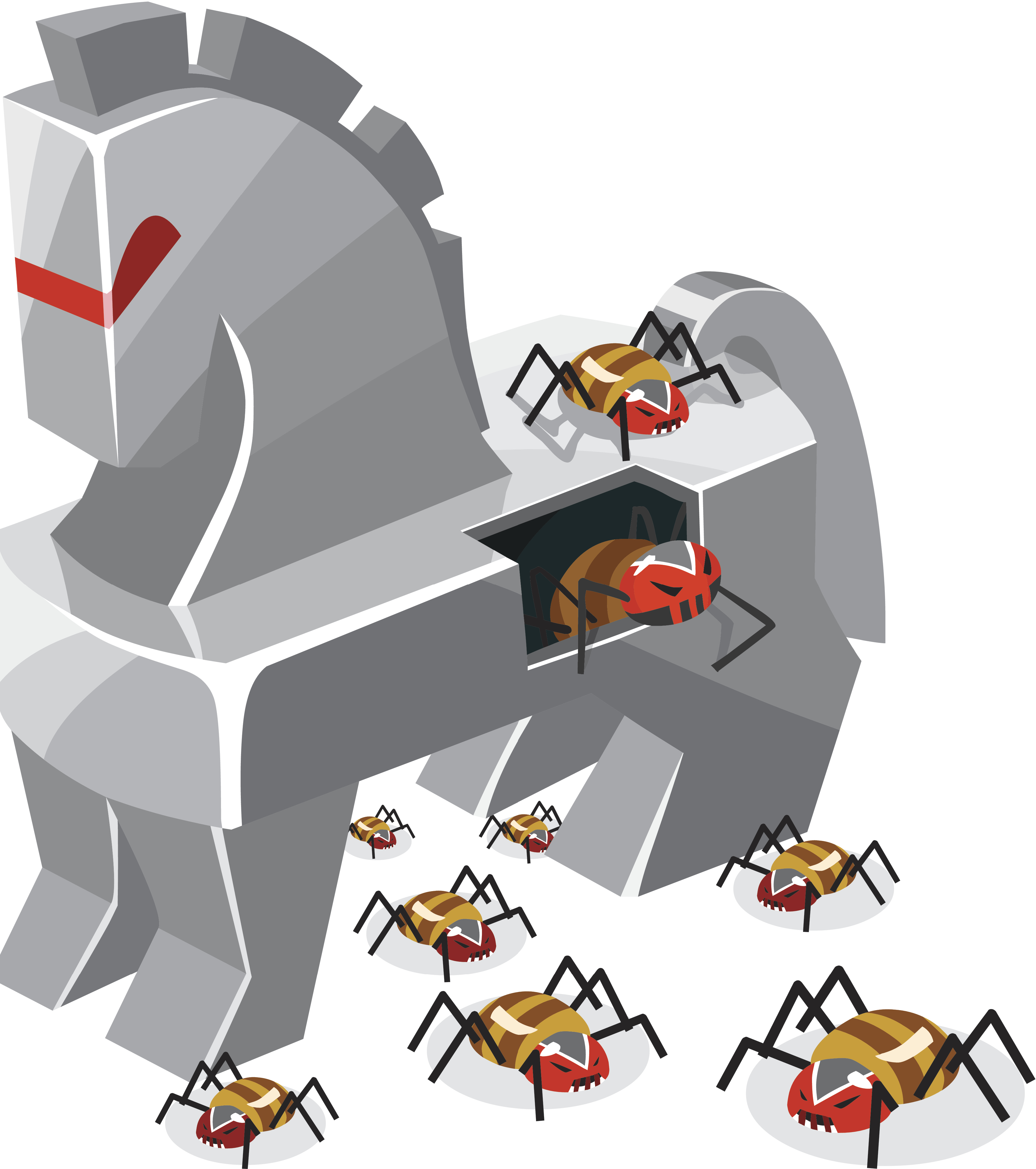
Trojan Horse

In our time, a "Trojan Horse" has come metaphorically to mean any trick or stratagem that causes a target to invite a foe into a securely protected bastion or place. The term is derived from the Ancient Greek story of the deceptive wooden horse that led to the fall of the city of Troy


Homer and the Roman poet Virgil wrote about the fall of Troy and the horse, though they didn't explain why the Trojans fell for the trick.

In the Aeneid, Prince Aeneas tells us that his fellow Trojans went out of the city to examine the deserted Greek encampment and found this enormous wooden horse. Was it a gift? Was it something of value that they just didn't want to haul back home?  They did not know it was filled with Greek soldiers. The Trojans were split on what to do with the horse but, at the urging of Thymoetes, they brought the horse into the city.

In Virgil's Aeneid, Book II[7] (trans. A. S. Kline), he tells this:
After many years have slipped by, the leaders of the Greeks,
opposed by the Fates, and damaged by the war,
build a horse of mountainous size, through Pallas's divine art,
and weave planks of fir over its ribs:
they pretend it's a votive offering: this rumour spreads.
They secretly hide a picked body of men, chosen by lot,
there, in the dark body, filling the belly and the huge
cavernous insides with armed warriors.

Our modern day version of a Trojan horse is usually a malicious computer program which tricks users into willingly running allowing it into their computer or device. This "Trojan horse" (or sometimes simply a "Trojan") is not like a computer virus or worm. Trojans generally do not attempt to inject themselves into other files or otherwise propagate themselves. And the worse part is that the victim allowed the attack to occur.

I suppose our modern Trojans are a form of social engineering, as was the Greek version in that the victims were duped. Today, it might come from opening an email attachment or link that looks friendly or tempts us with a gift or great offer.