When I wrote this post in 2010, it was about popular baby names at that time and particularly the effect of the Twilight movie series on baby names. What I didn't expect was how popular the post would be over the years - and that it would create another "Twilight effect."
When a post gets a lot of hits/visits, it moves up in my site's rankings and also in the way search engines rank pages. That attracts visitors and it also attracts spammers. (Hello India!) This post (in its original 2010 form) got more spam comments than any other post. It is not the most popular post here but it is the most popular with spammers who want to leave a comment with links to their sites or services. I took down the post for a few weeks and made some changes to the post and title in 2021but it still had the "twilight spam effect."
Looking back at the top baby names in 2009 shows that Moms and Dads were looking to popular vampire books and the first family for baby names. Fame can be fleeting - Miley (Cyrus) and Jonas (as in the brothers) took a stock market dive at the end of 2009.
Isabella was the top baby name for girls, Jacob for boys. Isabella’s climb to the top in 2009 ended Emma’s one-year reign. Jacob is on an 11-year run at the top. The surname of the Twilight movie series vampire Edward Cullen became the fastest-rising baby boy name in 2009.
Barack didn’t crack the top 1,000 for boys in 2010, but a version of President Obama's daughter’s name, Malia, was the fastest riser for girls. Maliyah moved up 342 spots, to No. 296, while Malia came in at No. 192, rising 153 spots.
Updating to now, we find these are the top U.S. names currently as supplied by the Social Security Administration from when parents were getting their baby a SS number so they could create all their official paperwork.
Here are some other sources if you are looking for baby names.
An adage is a short, memorable, usually philosophical saying. These kinds of saying go by any number of other names, and though there are probably distinctions, they seem pretty similar to me. For example, aphorisms, proverbs and bywords are close synonyms.
I did find that an adage that describes a general moral rule is usually called a "maxim". An aphorism seems to be more of an expression that seems "deep" and may not be widely used. But, one that is witty or ironic seems to get the tag "epigram".
Some more modern adages get labeled as "laws" or "principles," such as Murphy's Law.
The word "aphorisms" comes from a book by that name by Hippocrates that is a series of propositions concerning the symptoms and diagnosis of disease and the art of healing and medicine. The first line is "Life is short, art long, opportunity fleeting, experience deceptive, judgment difficult."
I found many lists of adages online that are very common, such as "Don't count your chickens before they hatch" and "Don't burn your bridges."
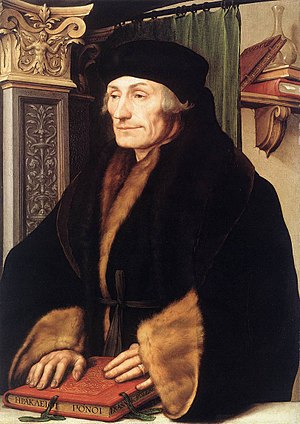
Erasmus, the compiler - by Hans Holbein
I was surprised to find how many adages come to us from the Dutch humanist Desiderius Erasmus Roterodamus, commonly known as simply Erasmus. He didn't create these. He compiled them. He published several volumes with the final edition of Adagia (1536) having more than 4,000. Most of them are annotated Greek and Latin proverbs that he compiled.
Here's a sampler of ones (translated to English) that you are likely to recognize:
More haste, less speed The blind leading the blind A rolling stone gathers no moss One man's meat is another man's poison Necessity is the mother of invention One step at a time To be in the same boat To lead one by the nose A rare bird Even a child can see it To have one foot in Charon's boat (To have one foot in the grave) To walk on tiptoe One to one Out of tune A point in time I gave as bad as I got (I gave as good as I got) To call a spade a spade Hatched from the same egg Up to both ears (Up to his eyeballs) As though in a mirror Think before you start What's done cannot be undone Many parasangs ahead (Miles ahead) We cannot all do everything Many hands make light work A living corpse Where there's life, there's hope To cut to the quick Time reveals all things Golden handcuffs Crocodile tears To lift a finger You have touched the issue with a needle-point (To have nailed it) To walk the tightrope Time tempers grief (Time heals all wounds) With a fair wind To dangle the bait Kill two birds with one stone To swallow the hook The bowels of the earth Happy in one's own skin Hanging by a thread The dog is worthy of his dinner To weigh anchor To grind one's teeth Nowhere near the mark To throw cold water on Complete the circle In the land of the blind, the one-eyed man is king No sooner said than done Neither with bad things nor without them (Women: can't live with 'em, can't live without 'em) Between a stone and a shrine (Between a rock and a hard place) Like teaching an old man a new language (Can't teach an old dog new tricks) A necessary evil There's many a slip 'twixt the cup and the lip To squeeze water out of a stone To leave no stone unturned Let the cobbler stick to his last (Stick to your knitting)
God helps those who help themselves
The grass is greener over the fence The cart before the horse Dog in the manger One swallow doesn't make a summer His heart was in his boots To sleep on it To break the ice Ship-shape To die of laughing To have an iron in the fire To look a gift horse in the mouth Neither fish nor flesh Like father, like son
Shrapnel is commonly the word given to pieces of a bullet, bomb or other explosives after they detonate.
The correct term for these pieces is "fragmentation"; "shards" or "splinters" can be used for non-preformed fragments. Though these pieces are often incorrectly referred to as "shrapnel", particularly by non-military media sources, you have no doubt heard the term used.
Henry Shrapnel is not a person I admire. He spent decades devising ways to develop bombs and shells that caused the most damage when they exploded. The original "shrapnel shell" was named for Major General Henry Shrapnel of the British Royal Artillery. It predates the modern-day high-explosive shell and operates by an entirely different process.
A shrapnel shell consists of a shell casing filled with steel or lead balls suspended in a resin matrix, with a small explosive charge at the base of the shell. When the projectile is fired, it travels a pre-set distance along a ballistic trajectory, then the fuse ignites a relatively weak secondary charge (often black powder or cordite) in the base of the shell. This charge fractures the matrix holding the balls in place and expels the nose of the shell to open a path for the balls, which are then propelled out of the front of the shell without rupturing the casing (which falls to earth relatively unharmed and can be retrieved and reused). These balls continue onward to the target, spreading out in a cone-shaped pattern at ground level, with most of their energy coming from the original velocity of the shell itself rather than the lesser force of the secondary charge that freed them from the shell. Since the cone of impact is relatively small, no more than 10 to 15 times the diameter of the shell, true shrapnel shells needed to be carefully sighted and judiciously used in order to maximize their impact on the enemy.
Aspirin tablets with enteric coating to ease stomach irritation
Bayer is a German pharmaceutical company. Friedrich Bayer received a patent for Aspirin in 1899. It is probably the most ubiquitous of nonprescription drugs.
It has its roots (pun intended) in the bark of the willow tree. The quest to create a synthetic version was an international endeavor.
Plants like willow and meadowsweet were used as pain remedies by Sumerians and Egyptians as early as 3000 BCE. The Greek physician Hippocrates reported giving willow-leaf tea to women in the throes of childbirth to help ease their labor pains.
In 1783, an English clergyman named Edward Stone wrote a letter to the Royal Society. He explained that, over five years, he had had consistent success in relieving ague and fever in his parishioners by giving them dried white willow bark. In 1828, a German pharmacy professor isolated the active ingredient in willow bark and named the bitter yellow crystals “salicin,” after the Latin name for white willow — Salix alba. Extracting the salicin from plants was difficult, and required a large amount of plant matter to produce the necessary quantity, so scientists went to work on a synthetic version.
A German chemist named Hermann Kolbe first synthesized salicylic acid in 1860. In 1895, a Bayer chemist named Felix Hoffmann was given the task of developing a “new and improved” synthetic salicylic acid product. He had a personal connection to the task. His father suffered from rheumatism but couldn’t take salicylic acid without vomiting because it irritated his stomach. Hoffmann studied the scientific literature and felt that combining an acetyl group with salicylic acid would yield a gentler product.
He came up with an effective synthetic version in 1897, and once it passed clinical trials, Bayer sought a patent for the brand name Aspirin.
The "A” for acetylsalicylic acid. The “-spir” for Spiraea ulmaria, or meadowsweet, which was a botanical source of salicylic acid. The "-in” because it was a common suffix for drugs at that time.
By 1950, it was the best-selling pain reliever in the world.
It is April first, but why is this April Fools' Day?
Go back to the 1500s in France when the Julian calendar (established by Julius Caesar) was replaced with the Gregorian calendar (introduced by Pope Gregory XIII and still used in most parts of the world) to find the story.
In the old Julian calendar, the new year began on April 1, but with the new Gregorian calendar, the new year was set to begin on January 1. News did not travel as fast in the 1500s as today. (That might not be a completely bad thing!) Some people didn't get this news that the start of the New Year had changed to January 1. That is a big change and those poor uninformed souls kept celebrating it on April 1. They were mocked as "April fools."
Pranks and April Fools' jokes started about the same time, so these jokes are also about 500 years old. The more effective ones rely on people not paying attention to the day being April first and often come early in the day.
Some jokes are a lot bigger and from more reliable sources than the ones you play on family or at the office. For example, in 1980 the BBC announced that Big Ben’s clock face was being changed to digital, and the first person to get back to the network could win the clock hands. There was outrage - and a lot of people trying to win the clock's hands.
In 1992, National Public Radio ran a segment saying that Richard Nixon was running for president again. They used a convincing actor and some people believed it. More outrage. Of course, Nixon resigned in disgrace in 1974.