09 March 2022

Crowded House

Crowded House, 1987 Paul Hester, Neil Finn, Nick Seymour

The rock band CROWDED HOUSE formed in 1985 after the band Split Enz did a farewell tour. Neil Finn (vocals, guitar, piano), drummer Paul Hester and Nick Seymour on bass. Finn and Hester had been members of the New Zealand band Split Enz. Neil Finn is the younger brother of Split Enz founding member Tim Finn, who would join the new band in 1990.

The new band was called The Mullanes and they formed in Melbourne with Finn, Hester, Seymour and guitarist Craig Hooper. When they got a record contract with Capitol Records, they decided to move to Los Angeles to record their eponymous debut album. Hooper didn't want to make the move and left the band. 

Their debut album produced  two Top Ten hits "Don't Dream It's Over" and "Something So Strong."

Capitol Records wanted (wisely) a new name for the band. The odd name "Crowded House" is a reference to the small Hollywood Hills house the band shared during the recording of the album Crowded House.

In 1996, Crowded House announced that it would disband and they did several farewell concerts. 

Hester died by suicide at age 46. the following year, the band re-formed with drummer Matt Sherrod and released two albums that reached number one on Australia's album chart. Then the band went inactive for several years until a revised line-up was set to tour the UK in 2020 with Neil Finn, Nick Seymour, Mitchell Froom, and Finn's sons Liam and Elroy. The COVID-19 pandemic postponed the tour.

The band's seventh studio album, Dreamers Are Waiting, was released in 2021 along with a New Zealand tour in March 2021. The band plans to tour Australia in 2022.


08 March 2022

Split Enz

Split Enz at Nambassa January 1979.jpg
Image: Nambassa Trust & Peter Terry, nambassa.com, CC BY-SA 3.0, Link

The New Zealand band Split Enz was very popular during the late 1970s and early 1980s. It was founded in 1973 by Tim Finn and Phil Judd, but had a number of band libeups during its existence. In the APRA Top 100 New Zealand Songs of All Time poll, the band led all bands with 8 songs. They released 7 studio albums.

In its earliest incarnation (1972), "Split Ends," was two university friends Tim Finn and Phil Judd writing original songs and their sound was eclectic and mostly acoustic. This Auckland band had Finn on vocals and piano, Judd on guitar and vocals and Mike Chunn on bass, Miles Golding on violin, and Mike Howard on flute.

After their November 1973 EMI NZ second single, "129" / "Sweet Talking Spoon Song" was when the group altered its name to Split Enz. The NZ can be seen as a reference to New Zealand.

Their debut LP Mental Notes (1975) did well on its first release, though sales were mostly in New Zealand and Australia. It hit #19 on the Australian album chart and #7 in New Zealand.

Band members came and went, breaks were taken and after a tour supporting Conflicting Emotions, Paul Hester joined on drums. Things were tense between brothers Tim and Neil (Neil having solo success) and it led to Tim's decision to leave Split Enz so that he could promote the release of his solo Escapade (1983) in Europe.

When it was decided to really end the band, Tim came back and the "Enz with a Bang" Australasian farewell tour happened in late 1984. Split Enz played its last show on 4 December 1984 in Auckland and a double album recorded on the farewell tour, The Living Enz, was released in December 1985.

Eventually, Neil Finn and drummer Paul Hester founded a new band, Crowded House. Tim Finn briefly joined Crowded House later. They also recorded two albums together as the Finn Brothers.


01 March 2022

Chicago and "25 or 6 to 4"


A collage used to promote Chicago in concert at the Chumash Casino Resort in Santa Ynez, California, 2005, Source

Chicago is an American rock band formed in Chicago, Illinois, in 1967. The group was initially billed as The Big Thing. They are a self-described "rock and roll band with horns" but also used elements of classical music, jazz, R&B, and pop music. They produced numerous top-40 hits over two decades and continue to record and perform live.


The logo of the American rock band, Chicago
The band logo which appears in many styles
 on their album covers, Public Domain, Link

There had been a Chicago-based rock cover band with six members called the Big Thing that played in Chicago nightclubs and covered Top 40 hits. When the group began working on original songs in 1968, their manager, James William Guercio, wanted a name change. They became the Chicago Transit Authority but changed it after their first album to the shortened Chicago to avoid legal action being threatened by the actual mass-transit company of the same name.

Their first record (April 1969), Chicago Transit Authority, is a double album, which is rare for a band's first release. It made it to No. 17 on the Billboard album chart and sold over one million copies by 1970, and was awarded a platinum disc. The album included a number of FM radio hits – "Does Anybody Really Know What Time It Is?", "Beginnings", "Questions 67 and 68", and "I'm a Man." The band was nominated for a Grammy Award for 1969 Best New Artist of the Year.

Amazon lists an incredible 186 albums under their name, which includes studio albums, live recordings and many compilations in different formats.

Chicago II

One song on their second album is "25 or 6 to 4." It was written by Robert Lamm, a founding member of the band. The song title has confused many listeners.

In a 2013 interview, keyboardist Robert Lamm said he composed it on a twelve-string guitar missing the two low E strings. He said the song is about trying to write a song in the middle of the night. The song's title is the time at which the song is set: 25 or 26 minutes before 4 AM. But other interpretations emerged. One was that it meant a quantity of illicit drugs. Another was that it was the name of a famous person in code. 


21 February 2022

canard


I heard a TV newscaster say that there is a group of Republicans who "have bought into Trump’s canard that the election was stolen from him." I have heard that word before and assumed it meant a hoax. My wife, a French speaker, said that the word canard in French means "duck." What's the connection?

She looked in one of her dictionaries and found a 16th-century French expression - vendre des canards à moitié. It literally means "to half-sell ducks" but this was possibly a proverb meaning "to fool" or "to cheat." The origin story isn't known but may have come from someone trying to cheat a customer in the sale of a duck at a market. Can you pass off half a duck as a whole duck and so half-sell it? We don't know. 

English speakers adopted this hoax or fabrication meaning of canard in the mid-1800s. 

There is also an aeronautical use of canard which has nothing to do with a hoax. In aeronautics, a canard is an arrangement wherein a small forewing or foreplane is placed forward of the main wing of a fixed-wing aircraft or a weapon. 

XB-70 Valkyrie experimental bomber

The term "canard" may be used to describe the aircraft itself, the wing configuration, or the foreplane. You find canard wings used in guided missiles and smart bombs.

This use of "canard" arose from the appearance of an aircraft called the Santos-Dumont 14-bis of 1906, which was thought to look like a duck with its neck stretched out in flight.

Santos - Nov12 1906 xcerpt.JPG
1906 Santos-Dumont 14-bis  CC BY-SA 3.0, Link

14 February 2022

Printing Part 2: hot off the press, stereotype, typecast, make a good impression

Earlier I had an earlier post about some words and phrases that come from the world of printing and this is part two. Most of the words and phrases are quite old and printing processes have changed a lot, but some of these are still in common usage. I picked up this information from the book Printer’s Error: Irreverent Stories from Book History

When you hear that something is "hot off the press" you know it's something new and up to date, but at one time it was something literally hot. In printing, it's not the paper or the press that is hot in temperature, it is the metal type itself. The Linotype machine invented by Ottmar Mergenthaler allowed compositors to type on a keyboard what they wanted to print and as they did so the machine would cast the type right there out of molten metal (mostly lead). 

This process really sped up the older typesetting process of arranging "cold" pieces of type letter by letter.

The etymology of the company name Linotype is supposed to have come from the owner of the New York Tribune who excitedly said, “You have done it; you have produced a line o’ type.”

Take the idea of creating thousands of exact printed copies from a single original setting of type further and you get the modern meaning. The term "stereotype" is still widely used to mean when it is assumed that every person from a single group is the exact same. "He is a stereotypical jock."

When an actor is chosen for a role because she fits a certain profile, she has been typecast. “Type” and “cast” are both printing words. Molten metal is poured into a mold in a process known as casting. An actor who "fits the mold" of a role is said to be typecast. "She is often typecast as the suburban mom."

When you meet someone for the first time, like on a date or in a job interview, you want to "make a good impression." The Latin word imprimere means “to press into or upon.” American printers would make a first printing or first edition but in British English a print run was an “impression.”

09 February 2022

Jane's Addiction

Jane's Addiction, Charlotte Verizon Amphitheater, June 12th, 2009


Jane's Addiction is an American alternative rock band formed in Los Angeles, California in 1985. The band's original line-up featured Perry Farrell (vocals), Dave Navarro (guitar), Eric Avery (bass) and Stephen Perkins (drums).

Jane’s Addiction - Teatro Caupolicán (10339365676).jpg
Dave Navarro and Perry Farrell  CC BY 2.0, Link

Jane's Addiction was one of the first bands to emerge from the early 1990s alternative rock movement and get some mainstream media attention, airplay, and commercial success. 

Their initial "farewell" tour was at the first Lollapalooza festival which was a showcase for alternative rock. Farrell claimed that the band became what he called the leaders of the "Alternative Nation".

The "Jane" in Jane's Addiction was an allusion to Farrell's housemate, Jane Bainter. In the book Whores: An Oral Biography of Perry Farrell and Jane's Addiction, it is said that Jane was a college graduate with a good job but that she had a heroin addiction. The "whore" in the book's title comes from a girlfriend of Eric Avery who worked as a prostitute and supported the band financially in the early days. It is said that Navarro had considered calling the band "Jane's Heroin Experience" with the "experience" being an allusion to the Jimi Hendrix Experience. The real Jane wasn't happy with her name being used at first. The band's song "Jane Says" addresses that. 


The band broke up in 1991, briefly reunited in 1997 and again in 2001 without Avery who declined to be involved. Then, in 2008, the band's "classic" line-up (with Avery) embarked on a world tour. Avery left again in early 2010 as the group began work on new material. The remaining members continued working and the band released its fourth studio album The Great Escape Artist in 2011. 


In 2016, Jane's Addiction was nominated for induction into the Rock and Roll Hall of Fame.

02 February 2022

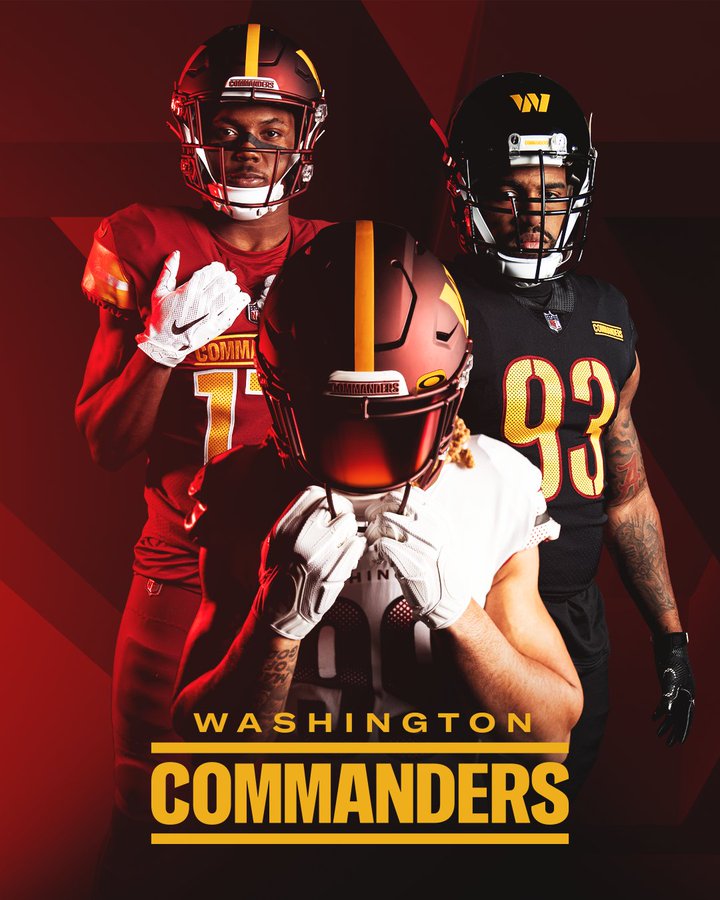
Washington Commanders


What's in a name? A lot.

After 87 years as the Redskins and 2 years as the Washington Football Team, the franchise announced today that its new name would be the Commanders.

The Redskins name which has offended Native American Indian tribes for many decades has been the subject of discussions for years without any movement. But that changed in mid-2020 when a letter signed by 87 investors and shareholders with a total worth of $620 billion was sent to sponsors FedEx, PepsiCo and Nike, asking them to stop doing business with the team unless its name was changed. 

There had been some fan input and one popular name among fans, RedWolves, was dropped because of trademarks held by others. Other names under consideration included Presidents, Brigade, Redhogs, Football Team, Armada, and Defenders.

The renaming process itself took 18 months and two full NFL seasons. 

Their new Twitter account is @Commanders