| Dickie Peterson, Randy Holden, and Paul Whaley in 1968 |
The band's name comes from the "Blue Cheer" which was a 1960's nickname for a high-quality LSD. The drug was promoted by "LSD chemist" and former Grateful Dead patron, Owsley Stanley.
| Dickie Peterson, Randy Holden, and Paul Whaley in 1968 |
Kwanzaa is a holiday celebrating African-American culture that is held from December 26 to January 1. It is a modern-day holiday based on African harvest festival traditions from various parts of Africa, including West and Southeast Africa.
American Maulana Karenga created Kwanzaa in 1966 during the aftermath of the Watts riots in Los Angeles as a specifically African-American holiday. Karenga said his goal was to "give blacks an alternative to the existing holiday of Christmas and give blacks an opportunity to celebrate themselves and their history, rather than simply imitate the practice of the dominant society."
Though it began as part of the 1960s "cultural revolution" and civil rights, it has become more of a family cultural celebration.
Karenga gave the origin of the name Kwanzaa as derived from the Swahili phrase matunda ya kwanza, meaning "first fruits". First fruits festivals exist in Southern Africa, celebrated in with the southern solstice, and Karenga was also inspired by an account he read of the Zulu festival Umkhosi Wokweshwama. He decided to spell the holiday's name with an additional "a" so that it would have a symbolic seven letters since the holiday would be 7 days in length and mark 7 principles.
Today is Boxing Day, a holiday celebrated after Christmas Day, occurring on the second or third day of Christmastide.
As with a number of holidays, it originated as a holiday with good intentions. Originally, it was a day to give gifts to the poor. Unfortunately, Boxing Day is now primarily known as a shopping holiday.
It originated in the United Kingdom and is celebrated in a number of countries that previously formed part of the British Empire.
![]() |
| ENGLISH OAK AND IRON ALMS BOX. ROCHE ABBEY. CIRCA 1450 |
The origin of the name "Boxing Day" is not definitive, but the European tradition of giving money and other gifts to those in need dates back to the Middle Ages. One possibility is that it refers to alms box (poor box) placed in the narthex of Christian churches to collect donations for the poor. There was also a custom in the late Roman/early Christian era of placing alms boxes placed in churches for the Feast of Saint Stephen which is on December 26.
In the early 1800s in Britain, Boxing Day was expanded to be the first weekday after Christmas day and seen as a time to give service people (postmen, errand boys, servants etc.) a "Christmas box."
Boxing Day is the 27th if the 26th is Christmas Sunday. The attached bank holiday or public holiday may take place either on that day or one or two days later (if necessary to ensure it falls on a weekday).
Boxing Day is not really marked in the U.S. but in Massachusetts it was declared in 1996 that every 26 December is Boxing Day, in response to the efforts of a coalition of British citizens to "transport the English tradition to the United States" though it is not an employee holiday.
| 1964 |
| 2016 |

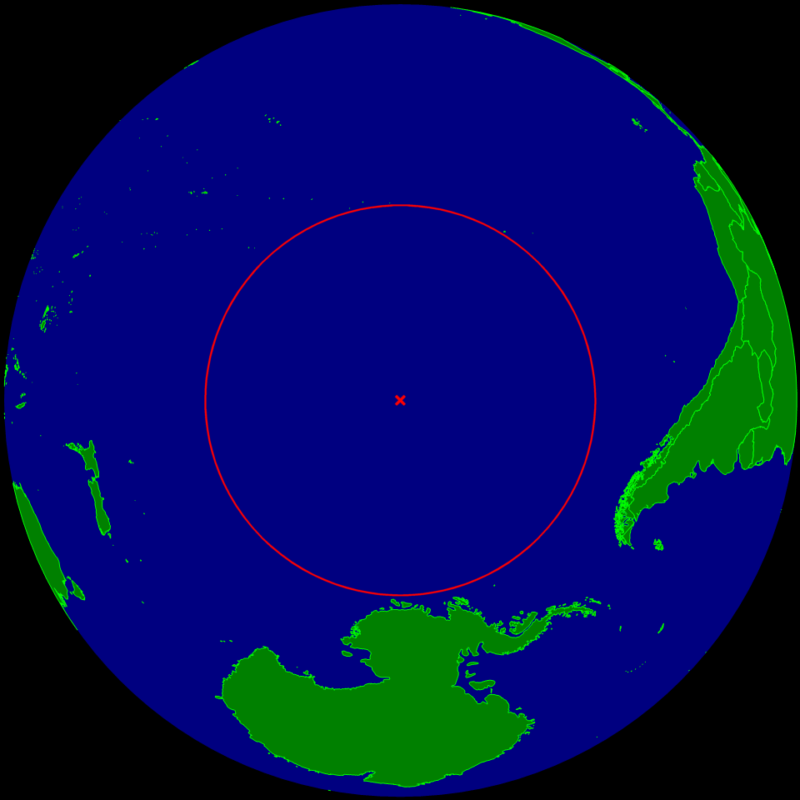
Point Nemo is quite literally in the middle of nowhere. In fact, though it is real, it is nowhere. At least it is not anywhere you can go to live if you want to get away from it all.
Is it a fictional place found in literature? No. It is a point in the Pacific Ocean. It is a spacecraft cemetery. It is the South Pacific Ocean Uninhabited Area. It is an oceanic pole of inaccessibility.
It's not the only one. Other poles of inaccessibility include the Eurasian Pole, in China and the Southern Pole of Inaccessibility in Antarctica.
Point Nemo is in the southern Pacific Ocean east of New Zealand. It has become where spacecraft that have reached the end of their usefulness are routinely de-orbited and destroyed.
It is a good spot to use since it is 2,688km away in every direction, to be precise, to the Pitcairn Islands, Moto Nui in the Easter Islands, and Maher Island in Antarctica.
The name, Point Nemo, might remind you of a certain animated fish, but that is not its origin. It has a double significance. “Nemo” is Latin for “no one” which certainly is appropriate for a place where no one will ever live. It also is an allusion to Jules Verne's submarine Captain Nemo from 20,000 Leagues Under The Sea.
Point Nemo is so isolated that the closest people to it are not on any of the nearest landmasses. Astronauts aboard the International Space Station are around 258 miles from their home planet at any given time, so they are the closest people to Point Nemo as they pass over it. The inhabited area closest to Point Nemo is more than 1,000 miles away.
For some more about Point Nemo see One-Page Schoolhouse and an expanded and more personal take on being in the middle of nowhere, check out this at Weekends in Paradelle.
J. Robert Cade was a physician and the lead inventor of Gatorade. When he was working in the renal (kidney) division of the University of Florida College of Medicine in 1965 when the Gators coach came to him with a question.
He wanted to know why his football players didn't need to urinate after a game. The answer was dehydration, a subject that had really been studied in relation to sports before.
The philosophy at the time was that athletes should not drink water during strenuous activities. The idea was that it make them sick to their stomachs.
Cade and his team began doing research and were surprised to find that players could lose as much as eighteen pounds of water weight during a three-hour game played in Florida heat.
The researchers then turned to experiment with a drink that could replace not only fluids but electrolytes. An electrolyte is a substance that produces an electrically-conducting solution when dissolved in a polar solvent, such as water.
The first version tasted terrible and further experiments were concerned with taste. Eventually, they hit on some effective strong flavors.
The University researchers initially considered naming their product "Gator-Aid" as something that could aid the Gator athletes. But using the "aid" suffix might require proving that the product had a clear medicinal use which would require clinical testing. Using "ade" (as in lemonade) would allow it could be classified as a soft drink.
Though Gatorade is best known as a sports drink, it is also used for postoperative patients, colonoscopy prep, and children suffering from diarrhea.
Gatorade's commercial success came with Stokely-Van Camp’s buying the rights to produce and market the drink. The Gatorade brand was purchased by the Quaker Oats Company in 1983, which, in turn, was bought by PepsiCo in 2000. The University of Florida gets 20 percent of the royalties and in 2015 reported that its total take from its royalties in Gatorade had risen to $281 million.
Gatorade is PepsiCo's fourth-largest brand based on worldwide annual retail sales and its biggest competition is Coca-Cola's Powerade and Vitaminwater (and Lucozade in the UK). In the United States, Gatorade accounts for approximately 75% of the market share in the sports drink category.
Once upon a time, there was a high school band called "The Nightriders" with Mark Volman, Don Murray and Dale Walton. Like most high school, garage bands, they went through changes in members. In 1963, they changed the band name to The Crossfires and began performing guitar-driven surf instrumentals. The band now included other Los Angeles high school students - Howard Kaplan (changed in 1965 to Kaylan), Al Nichol, and Chuck Portz. The Crossfires as a surf-rock group was active from 1963 to 1965.
![]() |
| The mystery of the locked room Photo: PxHere |
Today, I think the first association people have with "mystery" is as a fiction genre in books and movies. In its earlier usages, it was more "mystical."
In Middle English, it had more of a sense of a mystic presence and was associated with hidden religious symbolism - "the "mysteries of the faith." The even earlier Old French form, mistere, or Latin mysterium came from the Greek mustērion.
That earlier religious meaning survives both in the sense of a mystery being something that is difficult or impossible to understand or explain. In its earliest usage, the secret rites of Greek and Roman pagan religions, or of any ancient or tribal religion, were mysteries known only to accepted initiates. This survives in "secret" societies such as the Masons.
Sometimes the practices or the skills of an activity that seem to be unknowable to most people are regarded as mysteries. Neuroscience and lots of technologies are mysteries to most people. Do you actually know how a movie "magically" appears on your TV screen or how your smartphone works?
When I was a youngster and getting some Catholic education, there were the mysteries of the faith that could only be understood through divine revelations. Otherwise, they were regarded as beyond human understanding.
The word is now used for many hidden or unsolved things, from the mysteries of the universe to a puzzle, riddle, or unsolved problem. These things are not unknowable, just unknown to some or unknown at this time. When you read that someone's financial records are "shrouded in mystery," at least that someone knows the answer to the mystery.