
28 August 2025

30 Seconds To Mars


30 SECONDS TO MARS
was started in 1998 by actor Jared Leto and his brother Shannon. Matt Wachter later joined the band as bassist and keyboard player. After working with guitarists kevin Drake and Solon Bixler, Tomo Miličević eventually came in to be the fourth member.
 
A reader, Mike Driscoll, alerted us to info on Wikipedia about the band's name origin. Former member Matt Wachter has said that the band's name "actually comes from a thesis that the band found online that was written by a former Harvard professor. And one of the subsections of the thesis was titled 'thirty seconds to Mars', and he goes on to talk about the exponential growth of technology that relates to humans and saying that we are quite literally thirty seconds to Mars. What it means to us is, we thought it best described our music, in short."

Then again, Jared Leto said in an interview that "the name 30 Seconds To Mars has little to do with space, the universe or anything like that. It is a name that works on several different levels. Most importantly, it is a good representation of our sound. It's a phrase that is lyrical, suggestive, cinematic, and filled with immediacy. It has some sense of otherness to it. The concept of space is so overwhelming and all-encompassing, I doubt there is a song written that doesn't fall within it."


Frontman Jared Leto and drummer Shannon Leto performing in Padua, Italy, in July 2013


To further clear (or muddy) the origin waters, Shannon Leto, supporting the Wachter explanation said that the name "represents a lot of things. This professor had a thesis. It was talking about where technology was going; the evolution of man and how that plays a role. A sub-category was 30 Seconds to Mars. It was like the exponential growth of humans. We are literally 30 seconds away from Mars. Everything is right here and right now; everything is just so crazy and fast."

As of this posting, the band has many albums available.

22 August 2025

Medical terms That Go Wider


I wrote something for another blog about how the word "viral" which originally was related only to viruses, but now describes content that spreads rapidly online. But there are a good number of words that started as medical terminology but have now gone wider than their original medical usage. Most of them are a very close metaphorical usage to the original usage. 

Trauma Originally: Physical injury or psychological damage. Now: Used broadly to describe emotional distress, e.g., “That breakup was traumatic.”

Fever Originally: Elevated body temperature due to illness. Now: Used metaphorically, like “Bieber fever” or “football fever.”

Inflammation Originally: Swelling and redness due to infection or injury. Now: Used in wellness circles to describe chronic health issues or even emotional states.

Contagious Originally: Easily spread disease. Now: Used for ideas, moods, or behaviors. "Her laughter is contagious.”

Diagnosis Originally: Identification of a disease. Now: Used for identifying problems in general. “The diagnosis is poor time management.”

Symptoms Originally: Signs of illness. Now: Used to describe signs of any issue. “The symptoms of burnout are clear.”

Addiction Originally: Compulsive drug use. Now: Used for anything habit-forming. “I’m addicted to this show.”

Obsessed / OCD Originally: Obsessive-compulsive disorder. Now: Often used casually to describe intense interest or perfectionism.

Depressed / Depression Originally: Clinical mental health condition. Now: Used to describe temporary sadness or disappointment.

14 August 2025

Bowling for Soup, Sh*t, Dollars and Columbine

The band Bowling for Soup's name originates from a Steve Martin comedy routine, specifically a skit called "Bowling for Shit" from his 1978 album, "Wild and Crazy Guy." 

The band, formed in 1994, initially considered using Martin's title but ultimately opted for Bowling for Soup as a more family-friendly alternative. The "Bowling for Soup" name stuck, despite being initially intended as a joke, because the band couldn't agree on anything better.

Bowling for Soup formed in Wichita Falls, Texas in 1994. The band consists of Jaret Reddick (lead vocals, guitar), Gary Wiseman (drums, percussion), and Rob Felicetti (bass, backing vocals, acoustic guitar). The band is best known for its singles "Girl All the Bad Guys Want", "1985", "Almost", "Punk Rock 101", and "High School Never Ends". The band is also known for performing the theme song for the Disney Channel animated series Phineas and Ferb, which is a bit surprising as most of their albums carry warning labels for language.  Reddick is the only original member as of 2025

Steve Martin was playing off an actual TV game show called Bowling for Dollars in which people could bowl to win cash and prizes. The show was popular in the 1960s and peaked in the 1970s. It was unique in that it differed from most TV game shows of the time, which were taped in either New York or Hollywood and broadcast nationally. Unlike these shows, Bowling for Dollars was produced by local TV stations and featured contestants from the immediate area. The show was actually a franchise, created by Bert Claster of Claster Television, also the creator of Romper Room. Episodes of Bowling for Dollars were taped either in a local bowling alley or on a pair of bowling lanes constructed right inside the TV studio. The show reached its heyday in the 1970s. 


Bowling for Columbine is a 2002 documentary film written, produced, directed, and narrated by Michael Moore. The documentary film explores what Moore suggests are the primary causes for the Columbine High School massacre in 1999 and other acts of gun violence. 

The film's title refers to the story that the two students responsible for the Columbine High School massacre attended a school bowling class at 6:00 AM on the day they committed the attacks at school. Later investigations showed that this was based on mistaken recollections, and it was concluded that they were absent from school on the day the attack took place.


A critical and commercial success, the film brought Moore international attention as a rising filmmaker and won numerous awards, including the Academy Award for Best Documentary Feature, the Independent Spirit Award for Best Documentary Feature, a special 55th Anniversary Prize at the 2002 Cannes Film Festival, and the César Award for Best Foreign Film. The film is widely considered one of the greatest documentary films of all time.


28 July 2025

Oasis


Oasis' Liam and Noel Gallagher      Photo: Will Fresch | CC BY-SA 2.0 

I see that the troubled band Oasis is back on tour this summer. Lead vocalist Liam Gallagher and his brother, guitarist Noel Gallagher, are quite a story. 

But first, a bit about the band name origin. The band was originally called The Rain and only featured one of the Gallagher brothers (Liam on vocals). Noel later joined, and it was then suggested by Liam that they change their name to Oasis.

Noel had a tour poster for the band Inspiral Carpets hanging on his bedroom wall. One venue for a gig was the Swindon Oasis Leisure Centre. Noel liked the word "Oasis" because it evoked a sense of a welcoming, idyllic place, which fit the band's aspirations at the time for their music.

But their history is hardly idyllic. The Gallagher brothers' tumultuous relationship is well-documented. Liam's on-stage antics often clashed with Noel's perfectionism, leading to heated arguments and physical altercations.

Noel, the primary songwriter, wanted to push the band's sound in new directions, while Liam preferred a more traditional rock approach.

Both brothers struggled with substance abuse, which further strained their relationship and impacted the band's performances.

Oasis's touring schedule and recording process were often marked by chaos, with canceled shows, delayed album releases, and reports of on-tour substance abuse.

In 2009, Noel Gallagher officially left Oasis due to "irreconcilable differences" with his brother. The remaining band members attempted to continue under the name Beady Eye, but ultimately disbanded in 2014. The brothers' feud continued even after the band's breakup, with both sides engaging in public jabs and insults. 

However, in recent years, they've seemed to call a truce, with Liam and Noel reportedly having a more cordial relationship.

Despite their internal struggles, Oasis released several critically acclaimed and commercially successful albums, including (What's the Story) Morning Glory? and Be Here Now, and a bigger catalog of collections and remastered albums.


24 July 2025

Black Sabbath

Black Sabbath in 1970. From left to right: Geezer Butler, Tony Iommi, Bill Ward, Ozzy Osbourne.

Black Sabbath in 1970. Left to right: Geezer Butler, Tony Iommi, Bill Ward, Ozzy Osbourne
Photo: Warner Bros. Records -  Public Domain,
Link


Black Sabbath was an English rock band formed in Birmingham in 1968 by guitarist Tony Iommi, drummer Bill Ward, bassist Geezer Butler, and vocalist Ozzy Osbourne. They are often cited as pioneers of heavy metal music. Their albums, Black Sabbath (1970), Paranoid (1970), and Master of Reality (1971) helped define the genre. The band had multiple line-up changes following Osbourne's departure in 1979, with Iommi being the only constant member throughout its history.
Previous names for the band had been the dreadful Polka Tulk Blues Band (either from a brand of talcum powder or an Indian/Pakistani clothing shop) Mythology and Earth. They changed to Black Sabbath in 1969. 

The traditional meaning of "sabbath" is of a day of religious observance and abstinence from work, kept by Jews from Friday evening to Saturday evening, and by most Christians on Sunday.

The band clearly was embracing the supposed annual midnight meeting of witches with the Devil and so a "black sabbath" suggests a "holy" day of witchcraft. 

They distinguished themselves through occult themes with horror-inspired lyrics and tuned-down guitars. 
 
The band discovered that there was another English group named Earth, so they made another name change. They saw the 1963 horror film Black Sabbath starring Boris Karloff on the marquee across from their rehearsal space. Osbourne and Butler wrote the lyrics for a song called "Black Sabbath", which they say was inspired not so much by the film but by the work of horror and adventure-story writer Dennis Wheatley. Butler also claimed that he had a vision of a black silhouetted figure standing at the foot of his bed. To further add to the occult of the song, it uses the musical tritone known as "the Devil's Interval."

The band's music, appearance, and lyrics were atypical of 1969, when music was more reflective of the 60s flower power, folk/rock, and peace & love hippie culture. 

Black Sabbath has sold over 70 million records worldwide, and are one of the most influential heavy metal bands of all time. 
 

Of Paranoid, Rolling Stone magazine said it "changed music forever," calling the band "the Beatles of heavy metal," and Time magazine called Paranoid "the birthplace of heavy metal," placing it in their Top 100 Albums of All Time. 

MTV placed Black Sabbath at number one on their Top Ten Heavy Metal Bands. VH1 ranked Black Sabbath's "Iron Man" the number one song on their 40 Greatest Metal Songs countdown.
 

Ozzy  -  2010 

John Michael "Ozzy" Osbourne (3 December 1948 – 22 July 2025) adopted the nickname "Prince of Darkness." In 2005 Osbourne was inducted into the UK Music Hall of Fame both as a solo artist and as a member of Black Sabbath.In 2006, he was inducted into the US Rock and Roll Hall of Fame with Black Sabbath bandmates Tony Iommi, Bill Ward, and Geezer Butler, and then in 2024, he was inducted into the Rock and Roll Hall of Fame for his solo career.
 
By 2025, he had lost his ability to walk due to Parkinson's disease. Osbourne died unexpectedly at his home in Buckinghamshire on 22 July 2025, aged 76, surrounded by his family. His death occurred 17 days after his final live performance at the Back to the Beginning farewell concert.

23 July 2025

Sports Idioms

Sports provide us with lots of idioms that are used in sports and sometimes in non-sporting situations.

To "call an audible" in American football means to improvise, often in the spur of the moment. The term is based on the practice of changing a play right before the play is run by the quarterback yelling some coded message to the team.

To "hit below the belt" comes to us from boxing. It means to act unfairly or unscrupulously, in disregard of the rules. To hit an opponent below their belt is an illegal move in boxing. Outside the ring, people use it to mean anything said or done that is a "low blow" and unfair.

If someone says that "the gloves are off," they could be borrowing from boxing or hockey. In boxing, fighting without gloves and bare fists is dangerous. Similarly, in ice hockey, when the gloves are off or player "drop the gloves," it means they have engaged in a fight, throwing off their gloves to punch with bare knuckles. This term is used both figuratively and literally. If two businessmen negotiating say "the gloves are off," it means that anything goes and they expect tough negotiations.

14 July 2025

Faster Pussycat


Faster Pussycat 2008 CC BY 2.0 by Ted Van Pelt

Faster Pussycat is an American rock band from Los Angeles, formed in 1985 by vocalist Taime Downe, who remains the only original member.

The original lineup with guitarists Greg Steele and Brent Muscat and bassist Kelly Nickels broke up in 1993. They released four studio albums to date: Faster Pussycat (1987), Wake Me When It's Over (1989), Whipped! (1992) and with a reformed version, The Power and the Glory Hole (2006). In the late 1980s and early 1990s, they sold over two million records worldwide.


Formed during the glam metal and glam punk boom of the 1980s, they took their name from the film Faster, Pussycat! Kill! Kill!. The film is a 1965 American exploitation film directed by Russ Meyer. It follows three go-go dancers who embark on a spree of kidnapping and murder in the California desert. It is known for (as are most Meyers' films) its violence, provocative gender roles, and what one critic called "dialogue to shame Raymond Chandler".It was a commercial and critical failure upon its initial release, but it has since become regarded as an influential "cult" film.


11 July 2025

scot-free

Someone on the news today was complaining that "President Trump is getting away scot-free too often." Nothing political here, but where did that word come from? It means doing something bad without suffering any consequences. 

Does “scot” have something to do with Scotland or someone named Scott? No, it seems to have come from Scandinavia and is rooted in the Old Norse language. That was the language across Scandinavia from roughly the 9th to 13th centuries. Around the 10th century, the word skot, meaning “payment,” made its way over to the British Isles, where it was anglicized as scot. 

It was used in Old English to mean the royal tax levied on locals, and this gave rise to the Old English term scotfreo, meaning “tax free.”

Moving from Old to Middle and then Modern English, the spelling changes, and so does the meaning. The OED shows several spellings from the 16th century: “scott fre” and “scotchfree” and the meaning became broader, meaning "to get away with anything.”

It would be unusual to hear it used today referring to taxes (though that might apply to Trump, too), and it is generally used in the sense of getting away with criminal or wrongful activity without punishment.


30 June 2025

In a French Restaurant

Despite my wife being fluent in French, I have learned very little of that language in our married life. Of course, there are many French [phrases that have made their way into fairly common usage in English. For example, here are three you might use or hear in a restaurant.


"À la carte" means that each dish on the menu is priced individually, rather than being part of a set meal. It literally translates to "according to the card"—referring to the menu card. While the correct French spelling includes the accent (À la carte), it’s commonly written without it in English. (We are lazy about that stuff.) The term describes a dining style where meals are selected and paid for item by item, unlike a table d’hôte arrangement, which offers a fixed-price menu for a set combination of courses.

Though the exact date of its first use in French is unclear, à la carte entered the English language in the early 19th century.


For Americans, it means "with ice cream on top"

The phrase "à la mode" is French for "in the fashion" or "fashionable", and originally had nothing to do with dessert topped by ice cream. 

In classical French cuisine, it describes dishes prepared in a particular style, like boeuf à la mode, a pot roast cooked with wine and herbs.

The term was anglicised as a noun – alamode, which was a form of glossy black silk, and it appeared in a 1676 edition of The London Gazette:

But Americans are familiar with this phrase as meaning "with ice cream." That twist appears to have emerged in the late 19th century. One of the earliest documented uses of à la mode to mean served with ice cream was in an 1895 article from the Chicago Daily Tribune, describing a pie topped with ice cream. From there, the term caught on and became a staple of American diner lingo.


The American chicken cordon bleu

When someone says a dish is "cordon bleu", they’re not just talking about chicken stuffed with ham and cheese. They’re basically saying it’s top-tier, five-star, “kiss-the-chef” level stuff.

The phrase is French for “blue ribbon”, which back in the days of the Bourbon kings wasn’t just something you won at a school science fair—it was literally the highest rank of chivalry. By 1727, English speakers had picked it up to mean elite quality — especially when it came to chefs.

Fast forward to 1827, when a cookbook titled Le Cordon bleu ou nouvelle cuisinière bourgeoise hit Paris, dishing out top-notch recipes. Then in 1895, a newsletter called La Cuisinière Cordon-bleu began sharing pro tips from real chefs. And in 1896, Cordon Bleu cooking classes kicked off in Paris’s fancy Palais Royal, training folks to sauté like royalty.

In short: if someone says your cooking is cordon bleu, you can proudly toss your spatula in the air and take a bow.

26 June 2025

Grateful Dead


Grateful Dead was originally called The Warlocks, until Jerry Garcia found out that another band had the same name. The band's founding members were Jerry Garcia (lead guitar and vocals), Bob Weir (rhythm guitar and vocals), Ron "Pigpen" McKernan (keyboards, harmonica, and vocals), Phil Lesh (bass guitar and vocals), and Bill Kreutzmann (drums)

The name, though sometimes mistakenly identified as coming from the Tibetan Book of the Dead, is a phrase that appears in the Egyptian Book of the Dead.

"In the land of the night, the ship of the sun is drawn by the grateful dead."

Supposedly, Jerry was intrigued by the story of a troubled soul who is put to rest by a traveler. The spirit then repays the favor by helping the traveler with his own quest.

The Grateful Dead were a symbol of the 1960s counterculture. Though they never achieved mainstream commercial success, their legion of Deadheads followers brought them financial success.

They are forever part of the Haight-Ashbury, San Francisco scene, where they regularly played at Ken Kesey’s acid tests.

In their earliest incarnation, they were a jug band/country/blues band, which they returned to to some degree in their acoustic American Beauty/Workingman's Dead period. Over their 40-year career, they played many musical genres including rock, folk, R&B, jazz, and psychedelic.

They are best known as a live band and toured almost continually during the 60s and early 70s. (There are many more live recordings - legitimate and bootleg - than studio releases.)


It's strange to think of the Dead having a "greatest hits" album since they never sought out commercial success, but they did hit the charts in the late 80s with “Touch of Grey.” Still, there is a Gratest Hits compilation available.

The band essentially ended with the death of Jerry Garcia in 1995, though members of the band still tour and release tracks as part of other ventures. Former members of the band, along with other musicians, toured as The Other Ones in 1998, 2000, and 2002, and as The Dead in 2003, 2004, and 2009. In 2015, the four surviving core members marked the band's 50th anniversary in a series of concerts in Santa Clara, California, and Chicago that were billed as their last performances together. There have also been several spin-offs featuring one or more core members, such as Dead & Company, Furthur, the Rhythm Devils, Phil Lesh and Friends, RatDog, and Billy & the Kids.


22 June 2025

Down to the Wire and Hands Down

Here are two sports idioms from horse racing that have gone beyond the sport. Both contain "down."

Horse Race #3

When something goes "down to the wire" we mean it goes to the very end or last minute. "The election went down to the wire." The term comes from the length of wire that was once stretched across a racetrack at the finish line. Now, that finish is recorded electronically. The figurative use of the phrase goes back to about 1900.

Outside of horse racing, if someone said, "Hands down, this is the best pizza I have ever eaten." In that usage, it means unconditionally. It can also be used to mean something done with great ease.

In horse racing, when a jockey wins hands down, it means that when the jockey is certain of victory, he or she drops their hands and relaxes the hold on the reins. 

The horse-racing phrase was first cited by OED in 1867, and its figurative usage was noted in 1913.


17 June 2025

Greenbacks, Bucks, Clams, Dead Presidents, Dough and Scratch

There are some informal (slang) names for U.S. paper currency. One fairly common term is "bucks." It likely originated from the early American practice of trading deerskins, known as buckskins, which were used as a unit of exchange. Over time, the term "buck" became a colloquialism for money. It's thought that this term was later applied to dollars and paper currency, becoming a widely used slang term.

The term "clams" for money likely originated in the mid-19th century in the United States. One theory is that it came from the expression "shell out," meaning to pay up or cough up money, which references the practice of using seashells, like clamshells, as currency or for decoration in some cultures. This term may have been shortened to "clams" as a slang term for money.

The term "dead presidents" likely originated in the late 19th or early 20th century, as many U.S. presidents were featured on various denominations of currency. The term gained popularity over time, particularly in the mid-20th century, as it became a common slang term to refer to paper money. It's worth noting that not all U.S. currency features presidents, but the term "dead presidents" stuck due to the prominent portraits of presidents like George Washington, Abraham Lincoln, and others on various denominations.

As with the previous terms, we have "likely" rather than definitive origin stories. The term "dough" for money likely originated from the idea that money is a vital resource, much like dough is a fundamental ingredient for bread. It's a basic necessity that helps things "rise" or progress. In the late 19th and early 20th centuries in the United States, "dough" became a popular slang term for money.

The term "scratch" for money probably comes from the idea of scratching out a living or making ends meet. It may also come from the notion of scratching together enough money to achieve something. In a street-level context, it might imply that it's a resource that's earned or scrounged up through effort. The term is often used in phrases like "scratch together" or "from scratch," emphasizing the idea of gathering or accumulating resources.


"Greenbacks" became a semi-official name for some currency in 1861when the Union introduced Demand Notes to fund the Civil War. United States Notes followed in 1862. Both were dubbed "greenbacks" due to their distinctive green ink, an anti-counterfeiting measure. 

As the first widespread US paper currency, these notes shared some similarities with today's bills, like the green color, but had notable design differences. Early $1 notes featured Treasury Secretary Salmon P. Chase and President Abraham Lincoln was on the $10 note. The backs showcased intricate wording or patterns, such as the crisscross sawhorse design. 

Initially, greenbacks were printed in larger sizes - 7 3/8 x 3 1/8 inches - until they were downsized to 6 1/8 x 2 5/8 inches in 1929.

04 June 2025

Calling Dibs and Playing Jacks

Have you ever "called dibs" on something? Let's say that a group of people decide to rent bicycles for a ride, and one person says, "I call dibs on the red one." "First dibs" is sometimes called to establish a claim on the first use or the ownership of something. 

What does that mean and where did this odd expression originate?

This slang term has been in use since the early 19th century. The origin is disputed, but the most common origin story is that it comes from an old children's game called dibstones.

Dibstones is a child's game, similar to jacks and dice games. A dibstone is a pebble used in the game as a counter. The pebbles or the discarded knucklebones of sheep have been used since the late 17th century.
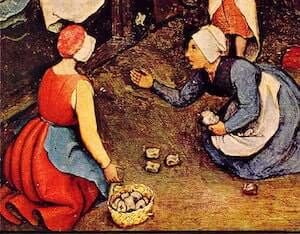
The game is from England, but the slang usage seems to be American. While playing, you can place a stone at your place to indicate a point. Similar to the modern slang usage, this means you have claimed a point.

To "call dibs" today is to claim a temporary right to something or to reserve it.


Pieter Bruegel the Elder - Children's Games - Knucklebones

The more common game of Jacks is also known as Knucklebones, Tali, or Fivestones. The games all have origins going back to ancient Greece and are mentioned by Sophocles and in the Iliad and Odyssey.

The games are usually played with five small objects (ten in the case of jacks). At one time, the game pieces were literally knucklebones, which are the astragalus bone in the ankle, or the hock of sheep. The jacks are thrown up and caught along with a ball or other object.

Modern jacks have six points/knobs and are usually made of metal or plastic. The simplest throw consists of either tossing up one jack, or bouncing a ball, and picking up one or more jacks/pebbles/knucklebones from the ground while it is in the air.

The games have a whole series of throws with odd names such as "riding the elephant", "peas in the pod", "horses in the stable", and "frogs in the well".

Sheep knucklebones used in the game

A variant on the previously mentioned games that is played by Israeli school-age children is known as kugelach or Chamesh Avanim ("five rocks"). Instead of jacks and a rubber ball, five die-sized metal cubes are used. The game cube is tossed in the air rather than bounced. 

here's also the Korean game Gonggi, another variant.

I was not able to find the origin and reason why the game or the game pieces are called "jacks."  Do any readers know?