26 November 2021

Point Nemo


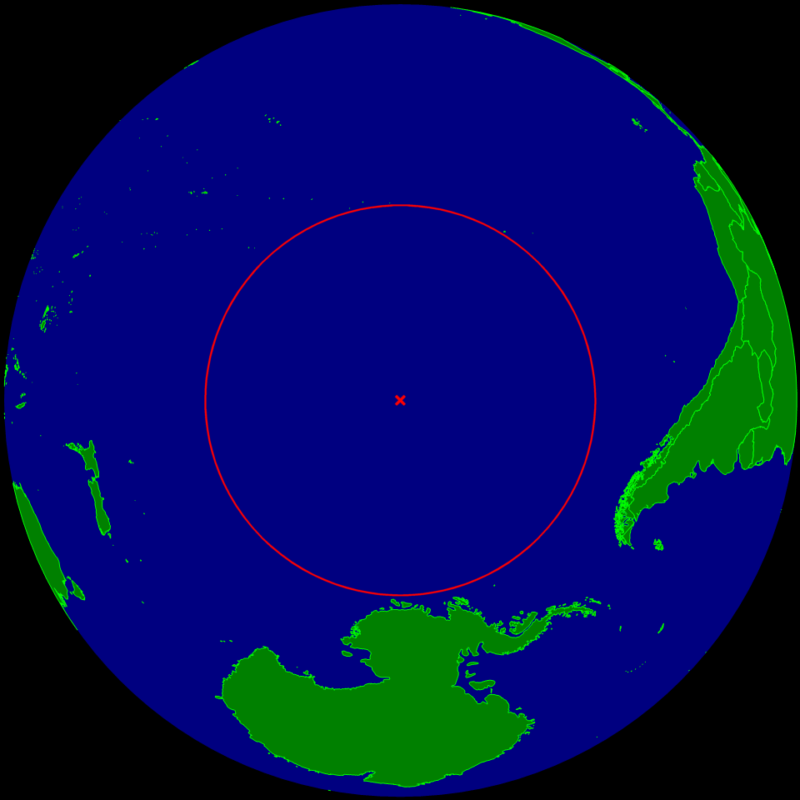
Point Nemo is quite literally in the middle of nowhere. In fact, though it is real, it is nowhere. At least it is not anywhere you can go to live if you want to get away from it all.

Is it a fictional place found in literature? No. It is a point in the Pacific Ocean. It is a spacecraft cemetery. It is the South Pacific Ocean Uninhabited Area. It is an oceanic pole of inaccessibility.

It's not the only one. Other poles of inaccessibility include the Eurasian Pole, in China and the Southern Pole of Inaccessibility in Antarctica.

Point Nemo is in the southern Pacific Ocean east of New Zealand. It has become where spacecraft that have reached the end of their usefulness are routinely de-orbited and destroyed.

It is a good spot to use since it is 2,688km away in every direction, to be precise, to the Pitcairn Islands, Moto Nui in the Easter Islands, and Maher Island in Antarctica.

The name, Point Nemo, might remind you of a certain animated fish, but that is not its origin. It has a double significance. “Nemo” is Latin for “no one” which certainly is appropriate for a place where no one will ever live. It also is an allusion to Jules Verne's submarine Captain Nemo from 20,000 Leagues Under The Sea

Point Nemo is so isolated that the closest people to it are not on any of the nearest landmasses. Astronauts aboard the International Space Station are around 258 miles from their home planet at any given time, so they are the closest people to Point Nemo as they pass over it. The inhabited area closest to Point Nemo is more than 1,000 miles away.

For some more about Point Nemo see One-Page Schoolhouse and an expanded and more personal take on being in the middle of nowhere, check out this at Weekends in Paradelle.

24 November 2021

Gatorade


J. Robert Cade was a physician and the lead inventor of Gatorade. When he was working in the renal (kidney) division of the University of Florida College of Medicine in 1965 when the Gators coach came to him with a question.

He wanted to know why his football players didn't need to urinate after a game. The answer was dehydration, a subject that had really been studied in relation to sports before.

The philosophy at the time was that athletes should not drink water during strenuous activities. The idea was that it make them sick to their stomachs. 

Cade and his team began doing research and were surprised to find that players could lose as much as eighteen pounds of water weight during a three-hour game played in Florida heat. 

The researchers then turned to experiment with a drink that could replace not only fluids but electrolytes. An electrolyte is a substance that produces an electrically-conducting solution when dissolved in a polar solvent, such as water.

The first version tasted terrible and further experiments were concerned with taste. Eventually, they hit on some effective strong flavors. 

The University researchers initially considered naming their product "Gator-Aid" as something that could aid the Gator athletes. But using the "aid" suffix might require proving that the product had a clear medicinal use which would require clinical testing. Using "ade" (as in lemonade) would allow it could be classified as a soft drink.

Though Gatorade is best known as a sports drink, it is also used for postoperative patients, colonoscopy prep, and children suffering from diarrhea. 

Gatorade's commercial success came with Stokely-Van Camp’s buying the rights to produce and market the drink. The Gatorade brand was purchased by the Quaker Oats Company in 1983, which, in turn, was bought by PepsiCo in 2000. The University of Florida gets 20 percent of the royalties and in 2015 reported that its total take from its royalties in Gatorade had risen to $281 million.

Gatorade is PepsiCo's fourth-largest brand based on worldwide annual retail sales and its biggest competition is Coca-Cola's Powerade and Vitaminwater (and Lucozade in the UK). In the United States, Gatorade accounts for approximately 75% of the market share in the sports drink category.

22 November 2021

The Turtles, Flo and Eddie and The Crossfires


Once upon a time, there was a high school band called "The Nightriders" with Mark Volman, Don Murray and Dale Walton. Like most high school, garage bands, they went through changes in members. In 1963, they changed the band name to The Crossfires and began performing guitar-driven surf instrumentals.  The band now included other Los Angeles high school students - Howard Kaplan (changed in 1965 to Kaylan), Al Nichol, and Chuck Portz. The Crossfires as a surf-rock group was active from 1963 to 1965.


When the rock and folk-rock sound became the most popular genres, they rebranded themselves as a folk-rock group under the name The Tyrtles. The stylized misspelling follows that of The Byrds and The Beatles but soon opted to correct the spelling.

Kaylan and Volman dropped the saxophones and became the band's vocalists with Kaylan as lead singer, and one of the keyboardists. Meanwhile, Volman began to harmonize with Kaylan's lead and became the third guitarist and percussionist in what was now a sextet.

They were now The Turtles on White Whale records. Their breakthrough hit was a cover of Bob Dylan's "It Ain't Me Babe" which reached the Billboard Top Ten in the late summer of 1965.


Their biggest hit is "Happy Together" which knocked the Beatles' "Penny Lane" out of number one on the Billboard Hot 100 in the spring of 1967. It was The Turtles' only #1 single and it remained there for three weeks.

In 1968, they released a concept album called The Turtles Present the Battle of the Bands. They recorded 11 songs in 11 different styles and pretended to be 11 different bands with names like "Nature's Children" and "The Fabulous Dawgs." They got two hits from the album:  "Elenore" and "You Showed Me" which h both made it into the top 10.

Their 1969 single "You Showed Me" (written by Gene Clark and Roger McGuinn of The Byrds) was their last top 10 single.

The Turtles released a second compilation album, More Golden Hits, and a B-sides and rarities album, Wooden Head in 1970 and disbanded.


Kaylan and Volman made an unlikely move and joined the Mothers of Invention. They used the name The Phlorescent Leech & Eddie. Their contract with White Whale Records prohibited them from using the name The Turtles or even their own names in billings! Eventually, the name was shortened to Flo & Eddie. They recorded with the Mothers, appeared in Zappa's film 200 Motels in 1971, and later released records on their own.

Starting in 2010, the Turtles Featuring Flo & Eddie toured throughout the United States as part of the "Happy Together" tour that has continued and has included other acts from the 60s and 70s such as Gary Puckett, Mitch Ryder, Mark Lindsay, Mark Farner, Gary Lewis, Micky Dolenz, the Buckinghams, the Cowsills, the Grass Roots, and the Association.