27 December 2021

Blue Cheer

Dickie Peterson, Randy Holden, and Paul Whaley in 1968


Blue Cheer was an American psychedelic blues-rock band that initially performed and recorded in the late 1960s and early 1970s in San Francisco. They were formed in 1966 by Dickie Peterson. He had been in a band, The Oxford Circle, with future Blue Cheer members Paul Whaley and Gary Lee Yoder. The band went through many personnel changes but eventually became a power-trio with bassist/singer Peterson, guitarist Leigh Stephens, and Whaley on drums.

They played in a psychedelic blues-rock style. They are also credited as being pioneers of heavy metal. Their cover of "Summertime Blues" is sometimes cited as the first in that genre. They are also considered by some to be early punk rockers, stoner rock, doom metal, experimental rock, and grunge. They were also widely considered to be the loudest band ever at the time when they emerged - loud to the point of pain for the audience. 

Their first hit was a cover version of Eddie Cochran's rockabilly "Summertime Blues" redone in a very hard rock version. It was on their debut album Vincebus Eruptum (1968). The single peaked at No. 14 on the Billboard Hot 100 chart, their only such hit. The album peaked at No. 11 on the Billboard 200 chart. In Canada, the single peaked at No. 3 on the RPM Magazine chart. 

The band's name comes from the "Blue Cheer" which was a 1960's nickname for a high-quality LSD. The drug was promoted by "LSD chemist" and former Grateful Dead patron, Owsley Stanley. 

Coincidentally, Cheer is a laundry detergent sold in the United States and Canada that was introduced in 1950. It had distinctive blue granules, which formerly gave it the nickname "Blue Cheer" though it was marketed primarily as just Cheer and still is sold. 

26 December 2021

Kwanzaa


Kwanzaa is a holiday celebrating African-American culture that is held from December 26 to January 1. It is a modern-day holiday based on African harvest festival traditions from various parts of Africa, including West and Southeast Africa. 

American Maulana Karenga created Kwanzaa in 1966 during the aftermath of the Watts riots in Los Angeles as a specifically African-American holiday. Karenga said his goal was to "give blacks an alternative to the existing holiday of Christmas and give blacks an opportunity to celebrate themselves and their history, rather than simply imitate the practice of the dominant society."

Though it began as part of the 1960s "cultural revolution" and civil rights, it has become more of a family cultural celebration.

Karenga gave the origin of the name Kwanzaa as derived from the Swahili phrase matunda ya kwanza, meaning "first fruits". First fruits festivals exist in Southern Africa, celebrated in with the southern solstice, and Karenga was also inspired by an account he read of the Zulu festival Umkhosi Wokweshwama. He decided to spell the holiday's name with an additional "a" so that it would have a symbolic seven letters since the holiday would be 7 days in length and mark 7 principles.

Boxing Day

Today is Boxing Day, a holiday celebrated after Christmas Day, occurring on the second or third day of Christmastide.

As with a number of holidays, it originated as a holiday with good intentions. Originally, it was a day to give gifts to the poor. Unfortunately, Boxing Day is now primarily known as a shopping holiday. 

It originated in the United Kingdom and is celebrated in a number of countries that previously formed part of the British Empire. 

ENGLISH OAK AND IRON ALMS BOX. ROCHE ABBEY. CIRCA 1450

The origin of the name "Boxing Day" is not definitive, but the European tradition of giving money and other gifts to those in need dates back to the Middle Ages. One possibility is that it refers to alms box (poor box) placed in the narthex of Christian churches to collect donations for the poor. There was also a custom in the late Roman/early Christian era of placing alms boxes placed in churches for the Feast of Saint Stephen which is on December 26.

In the early 1800s in Britain, Boxing Day was expanded to be the first weekday after Christmas day and seen as a time to give service people (postmen, errand boys, servants etc.) a "Christmas box."

Boxing Day is the 27th if the 26th is Christmas Sunday. The attached bank holiday or public holiday may take place either on that day or one or two days later (if necessary to ensure it falls on a weekday). 

Boxing Day is not really marked in the U.S. but in Massachusetts it was declared in 1996 that every 26 December is Boxing Day, in response to the efforts of a coalition of British citizens to "transport the English tradition to the United States" though it is not an employee holiday.

18 December 2021

The Rolling Stones

01 - The Rolling Stones

The Rolling Stones are still often referred to as "the world's greatest rock and roll band." The English band was formed in April 1962. The original members were guitarist and harmonica player Brian Jones, pianist Ian Stewart, vocalist Mick Jagger, guitarist Keith Richards and Bill Wyman on bass with drummer Charlie Watts.

Their early setlists relied heavily on rhythm and blues songs and straight-ahead blues. Brian Jones and Keith Richards were big fans of Chess Records' artists such as Muddy Waters, John Lee Hooker and Howlin' Wolf and their Chicago blues style.

Muddy Waters' song "Rollin' Stone" was the inspiration for the band's name. According to Wikipedia, Jones named the band during a phone call interview with Jazz News. When asked  for the band's name - and they hadn't decided on one - Jones saw a Muddy Waters LP lying on the floor and took the song name. After signing to Decca Records in 1963, the band changed their name from "The Rollin' Stones" to "The Rolling Stones". Many fans and even the band members refer to the band as simply "The Stones."

Chess Records was based in Chicago, Illinois and was also the home to other artists they admired including seminal rockers like Chuck Berry and Bo Diddley. Their most famous studio was on South Michigan Avenue and The Rolling Stones recorded an instrumental track titled "2120 South Michigan Avenue" there during their first U.S. tour in 1964. They recorded in the Chess Studios on two more occasions. (The building is now home to Willie Dixon's Blues Heaven Foundation.)

1964

Brian Jones actually led the band until Jagger and Richards' songs became the bands' big early hits and they took the lead roles. By 1969, Jones' contributions to the records had diminished and after he was unable to tour the United States for legal reasons, he left the band by mutual agreement. Jones' died in 1969. Mick Taylor was the replacement guitarist from 69-74. He was later replaced by Ronnie Wood from The Faces.

2016


The Rolling Stones discography includes 25 studio albums, 10 live albums, and more than 30 compilation albums including multiple "greatest hits" collections. 

26 November 2021

Point Nemo


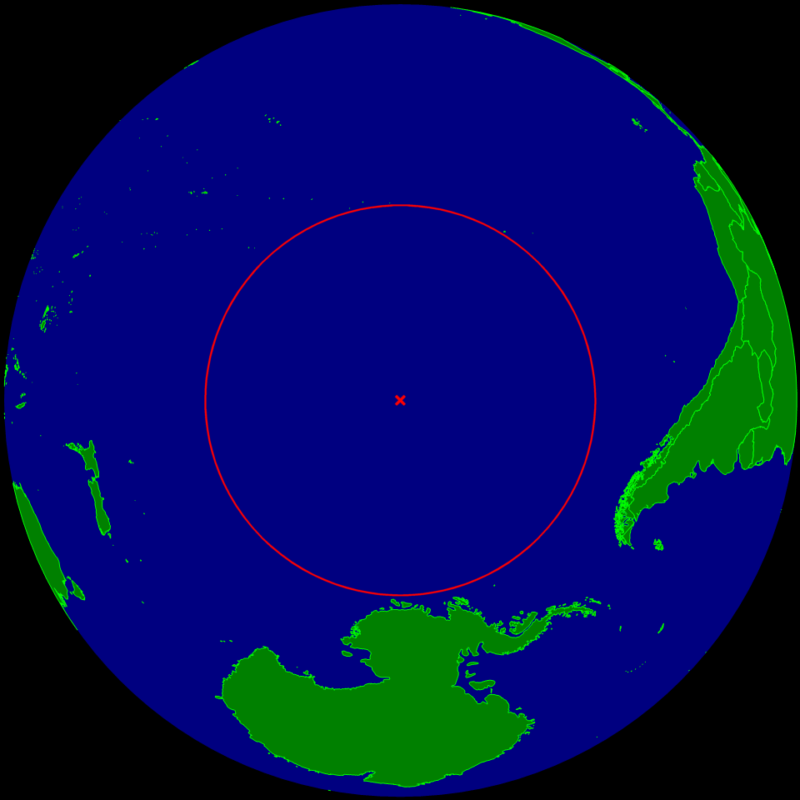
Point Nemo is quite literally in the middle of nowhere. In fact, though it is real, it is nowhere. At least it is not anywhere you can go to live if you want to get away from it all.

Is it a fictional place found in literature? No. It is a point in the Pacific Ocean. It is a spacecraft cemetery. It is the South Pacific Ocean Uninhabited Area. It is an oceanic pole of inaccessibility.

It's not the only one. Other poles of inaccessibility include the Eurasian Pole, in China and the Southern Pole of Inaccessibility in Antarctica.

Point Nemo is in the southern Pacific Ocean east of New Zealand. It has become where spacecraft that have reached the end of their usefulness are routinely de-orbited and destroyed.

It is a good spot to use since it is 2,688km away in every direction, to be precise, to the Pitcairn Islands, Moto Nui in the Easter Islands, and Maher Island in Antarctica.

The name, Point Nemo, might remind you of a certain animated fish, but that is not its origin. It has a double significance. “Nemo” is Latin for “no one” which certainly is appropriate for a place where no one will ever live. It also is an allusion to Jules Verne's submarine Captain Nemo from 20,000 Leagues Under The Sea

Point Nemo is so isolated that the closest people to it are not on any of the nearest landmasses. Astronauts aboard the International Space Station are around 258 miles from their home planet at any given time, so they are the closest people to Point Nemo as they pass over it. The inhabited area closest to Point Nemo is more than 1,000 miles away.

For some more about Point Nemo see One-Page Schoolhouse and an expanded and more personal take on being in the middle of nowhere, check out this at Weekends in Paradelle.