01 December 2024

Chrismukkah

Hanukkah bush.jpg

Chrismukkah is a pop-culture portmanteau neologism referring to the merging of the holidays of Christianity's Christmas and Judaism's Hanukkah. 

The term was popularized beginning in December 2003 by the TV drama The O.C., in which the character Seth Cohen creates the holiday to signify his upbringing in an interfaith household with a Jewish father and Protestant mother. 

The holiday can also be adopted by all-Jewish households that celebrate Christmas as a secular holiday.

The term first arose in the German-speaking countries among middle-class Jews in the 19th century. 

After World War II, Chrismukkah became particularly popular in the United States but is also celebrated in other countries.

For a deeper and more personal take on this, see my post today on Weekends in Paradelle. 


25 November 2024

tempest in a teapot and variations


German artist Carl Guttenberg's 1778 engraving of an exploding teapot to represent the American Revolution. Father Time, on the right, flashes a magic lantern picture of an exploding teapot to America on the left and Britannia on the right, with British and American forces advancing towards each other.

Tempest in a teapot (American English), or storm in a teacup (British English), or tempest in a teacup, are all idioms meaning a small event that has been exaggerated out of proportion. There are also lesser-known or earlier variants, such as storm in a cream bowl, tempest in a glass of water, storm in a wash-hand basin, and storm in a glass of water. We find the French une tempête dans un verre d'eau (a storm in a glass of water) and Chinese: 茶杯裡的風波、;  茶壺裡的風暴 (winds and waves in a teacup; storm in a teapot)

The etymology appears to go way back to Cicero in the first century BC. In his De Legibus, he used a similar phrase in Latin, possibly the precursor to the modern expressions, Excitabat enim fluctus in simpulo ut dicitur Gratidius, which is translated as "For Gratidius raised a tempest in a ladle, as the saying is."

One of the earliest occurrences in print of the modern version is in 1815, where Britain's Lord Chancellor Thurlow, sometime during his tenure of 1783–1792, is quoted as referring to a popular uprising on the Isle of Man as a "tempest in a teapot."

Lord North, Prime Minister of Great Britain, is credited for popularizing this phrase as characterizing the outbreak of American colonists against the tax on tea. This was satirized in Carl Guttenberg's 1778 engraving of the Tea-Tax Tempest (shown above).


13 October 2024

punk


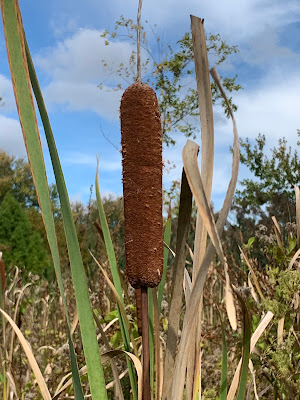
cattail

I wrote elsewhere about something that was part of my New Jersey childhood autumns. We would gather cattails, dry them, light them, and blow out the flaming tip so there was a glowing and smoking tip. Some people said the smoke kept away mosquitoes and bugs, but honestly, we just liked the fire and smoke.

We called them punks, but until I wrote about that, I had no clue why that was the name we used for them. It may be a Jersey thing. There were also very small, manufactured punks that are still sold and are used as a lighter for fireworks and as an unscented incense stick. 

Doing a bit of etymological research, I found the more common usages of the word.

I suspect that today, the most common usage might be as an adjective describing a loud, fast-moving, and aggressive form of rock music, popular in the late 1970s and early 1980s. Some of the genre's followers with their colored spiked hair and clothing decorated with safety pins or zippers could be called punks.

Earlier in North America, to call someone a punk would be saying they were a worthless person. The word shows up in 1950s movies, TV, and books as being close to being a criminal or hoodlum.

Slightly less derogatory American usage would be using it to describe an inexperienced young person or novice.

As a verb, it can be used to mean being tricked or deceived.

In sports, it can mean to totally beat or defeat an opponent.

The word's origin is late 16th century. I found that in an archaic sense, it meant a prostitute. 

The closest I can find for my childhood usage is a North American, late 17th century (as noun) usage of uncertain origin, meaning a soft, crumbly wood that has been attacked by fungus, used as tinder to start a fire.