17 October 2022

Montreal Expos

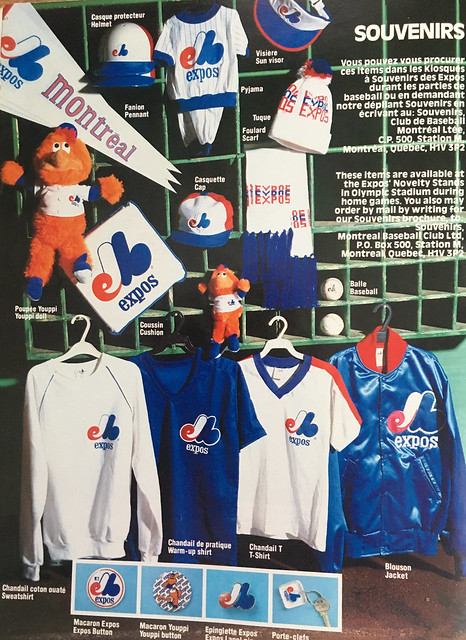
Montreal Expos programme photo

Before Major League Baseball expanded to Montreal in 1969, there were minor league teams in Montréal and they were usually named the "Royals." This was a reference to Mount Royal (French: Mont Royal), which is located west of today's downtown and after which the city was named.

The Montréal Expos (French: Les Expos de Montréal) were a Canadian professional baseball team there. They were the first Major League Baseball (MLB) franchise located outside the United States.

The Expos were named in honor of Expo 67, which was the World's Fair (exposition) held two years before the Expos began play.

They played in the National League (NL) East Division from 1969 until 2004.  They have no World Series Titles.

In 1994, a players' strike wiped out the last eight weeks of the season and all of the post-season. Montreal was in first place by six games in the National League East Division when play was stopped, but no official titles were awarded in 1994.

Their top franchise players were Gary Carter, Andre Dawson, Vladimir Guerrero, Pedro Martinez, Tim Raines, Steve Rogers, Rusty Staub, and Jose Vidro.

Following the 2004 season, the franchise relocated to Washington, D.C., and became the Washington Nationals and the "Expos" name was retired.

Montréal currently has no MLB team.  The Kansas City Royals team name has no connection to the old Montréal teams by that name.

12 October 2022

Why name the Americas "America?"

America is named after Amerigo Vespucci, the Italian explorer. He is the man who set forth what was then considered to be a revolutionary concept: that the lands that Christopher Columbus sailed to in 1492 (but didn't actually land on) were part of a separate continent. 

A map created in 1507 by Martin Waldseemüller was the first to depict this new continent with the name "America," a Latinized version of "Amerigo."

Detail of the Waldseemüller map showing the name "America."
The Library of Congress purchased of the only known extant copy of this map
for $10 million, thanks to the generosity of the U.S. Congress, Discovery Channel, Gerald Lenfest, David Koch and several other donors.

Waldseemüller's large world map included map data that had been gathered by Vespucci during his voyages of 1501-1502 to the New World. he named the new lands "America" on his 1507 map in the recognition of Vespucci's understanding that a new continent had been discovered.

See www.loc.gov/wiseguide/aug03/america.html

03 October 2022

Yo La Tengo

Yo La Tengo, 2010  L-R: McNew, Hubley, and Kaplan


Yo La Tengo is an American alternative rock band formed in Hoboken, New Jersey in 1984. Since 1992, the lineup has consisted of Ira Kaplan (guitars, piano, vocals), Georgia Hubley (drums, piano, vocals), and James McNew (bass, vocals).

The band has had some commercial success, but has always been known as a "critics' band" and has a devoted cult following especially in the NY/NJ area. They are known for having an incredible repertoire of cover songs in live performances and often does radio request appearances on WFMU

You La Tengo translates to "I have it" in Spanish. It is said to be the phrase called out by Hispanic baseball players when fielding a pop fly ball. Ira Kaplan picked up the expression from the book The Five Seasons by Roger Angell. 


30 September 2022

Naming the Asteroids


I wrote earlier about 3200 Phaethon, the asteroid that causes us to see the Geminid meteor showers that appear in December. The first asteroids to be discovered were named for characters from classical mythology, such as Ceres and Juno. But the International Astronomical Union (IAU) now regulates the naming of asteroids, and names are no longer restricted to only mythological characters.

The naming of heavenly bodies and celestial objects is quite interesting. An article from the Open University, says that an asteroid is not awarded a name until it has been observed long enough for its orbit to be determined with a fair degree of precision, which may take several years.

The “permanent designation” is a rather boring number issued in strict numerical sequence, but the discoverer is invited to suggest a name for approval by a special committee of the International Astronomical Union.

As we begin to be able to land on these asteroids, the idea of mining asteroids becomes less science-fiction and more like an actual space industry.

There are some much more unusual or whimsical names.

7758 Poulanderson is named after a science fiction author Poul Anderson.

I quite like that object 8749 is named "Beatles" after best known of all rock bands. In addition to 8749 Beatlesthere are four consecutively numbered minor planets named after the individual members of The Beatles:

The Beatles are not alone in being pop musicians with celestial objects bearing their names. Elvis, Frank Zappa, Jerry Garcia, the Rolling Stones (which seems appropriate for these rocks), Frank Sinatra, George Gershwin, Led Zeppelin, Procol Harum, Bruce Springsteen and many others are all floating out there.

And fictional names also get their place in space. From Beowulf to Bilbo Baggins, Sherlock Holmes and Mr. Spock.

The number 5460 asteroid has the name Tsenaat'a'i which means “flying rock” in the Navaho language.

A name of pure invention, and some difficulty to pronounce at first glance, went to object 2037. It is named Tripaxeptalis. It is pronounced to sound like tri Pax sept Alice. The etymology of that is that its permanent designation is three times (tri) that of asteroid 679 Pax and seven times (sept) that of number 291 Alice.


29 September 2022

Naming the Comets

Time-lapse of Comet 2I Borisov

An artist’s impression of `Oumuamua as a dark red highly-elongated metallic or rocky object,
about 400 meters long, and unlike anything normally found in the Solar System.

On December 8 this year, a newly discovered comet looped around our Sun after a journey of more than 100 million years from the birth of some very distant star. It makes its closest pass to Earth today and then heads out of our solar system again. By the middle of 2020, the comet will streak past Jupiter's distance of 500 million miles on its way back into interstellar space where it will drift for untold millions of years before skirting close to another star system.

It's only the second interstellar object to visit us, so it's a big deal. But it has the very boring name of "Comet 2I Borisov." It was discovered by Gennady Borisov, a Crimean astronomer, and, of course, he wanted his piece of history.

A much more interesting name goes to the first interstellar object to visit our solar system. That was ʻOumuamua.

The International Astronomical Union assigns designations for astronomical objects and they originally classified it as Comet C/2017 U1. Then it was reclassified as the equally boring asteroid A/2017 U1. The renaming was because it had no "coma" - the nebulous envelope around the nucleus of a comet formed when the comet passes close to the Sun and warms so that it gets a "fuzzy" appearance when viewed in telescopes and distinguishes it from stars. The word coma comes from the Greek "kome" (κόμη), which means "hair" and is the origin of the word comet itself.

Once this comet was identified as coming from outside the Solar System, a new designation was created: I, for Interstellar object. ʻOumuamua, as the first object so identified, was designated 1I but is also referred to as 1I; 1I/2017 U1; 1I/ʻOumuamua; or 1I/2017 U1 (ʻOumuamua). I'm only interested in ʻOumuamua.

What caught my attention first was that first character which is a Hawaiian ʻokina, and not an apostrophe. It is pronounced as a glottal stop.  The name comes directly from the Hawaiian word ʻoumuamua, meaning "scout," because the object has come from so far away to check us out. The name was chosen by the Pan-STARRS team in consultation with Kaʻiu Kimura and Larry Kimura of the University of Hawai‘i at Hilo. It was discovered by Robert Weryk using the Pan-STARRS telescope at Haleakala Observatory, Hawaii.


That is a much better name than 1I. But I would have been quite happy if they had gone with another suggested name: Rama. That is the name given to an alien spacecraft discovered under similar circumstances in the 1973 science fiction novel Rendezvous with Rama by Arthur C. Clarke. It's a novel I really enjoyed reading. That object was seen as an alien craft that was on a scouting expedition checking out the rest of the universe.

 ʻOumuamua is tumbling, rather than smoothly rotating, and is moving so fast relative to the Sun that there is no chance it originated in the Solar System and it cannot be captured into a solar orbit. It will leave our Solar System and resume traveling through interstellar after roughly 20,000 years of travel in the Solar System.

ʻOumuamua's planetary system of origin and the amount of time it has spent traveling amongst the stars are unknown. I love that mystery.

22 September 2022

Ultima Thule

It is more difficult to get the public interested in celestial objects when they have names like "2014 MU69." Astronomers tend to name things initially and officially in that way but "sexier" names seem to come later more and more. (see this about that) This is a good thing. This site asks, "What's in a name?" A character from Shakespeare might say it doesn't matter, but I say it matters a lot.

The NASA team that works with the New Horizons exploratory spacecraft gave 2014 MU69 the nickname of Ultima Thule. Much better.

Thule was a mythical island that appeared on some old maps as being at the edge of the known world. It was also labeled as "Tile" on at least one map from 1539 called the Carta Marina. This was a map of what Nordic sailors knew about the world. They placed Thule near the Faroe Islands.

The Faroe Islands are not mythical. They (AKA Faeroe Islands) are a North Atlantic archipelago located 200 miles (320 km) north-northwest of the United Kingdom and about halfway between Norway and Iceland. Today they are an autonomous country of the Kingdom of Denmark with a total area of about 540 square miles and a population of over 50,000.

The direct translation of Ultima Thule is “beyond Thule” and is a very fitting name for something beyond the edges of our currently known world.

If you want to know a bit more about the space exploration side of Ultima Thule, check out this post on one of my other blogs. 

Thule (TILE) near the Faroe Islands - Carta Marina map, 1539.

20 September 2022

Kodak

An original Kodak camera

The company we know as Kodak was once known as the Eastman Kodak company. Digital photography and video killed most of their business which ranged from the average consumer to the big Hollywood movie studios. The company is not a big player in either market these days, but it once ruled the American film and photography business.

George Eastman received a patent for the first film camera in 1888. Eastman had been an enthusiastic photographer but found bulky cameras and heavy, breakable glass plates cumbersome and inconvenient. He wanted to make it easier for people to take up photography.

By 1880, he had improved on the previous photographic plate, so he formed his own business. He then developed cellulose film which could be rolled onto a spool which eliminated the need for plates altogether. 

Next, he designed a camera that could make use of a roll of film and he obtained a patent for that invention, which came to be known as the Kodak box camera. The box camera could hold enough rolled film to shoot 100 exposures and it completely revolutionized the art and science of photography. 

The genius of his company is summarized in the slogan he patented - “You press the button. We do the rest.” They sold you the camera, sold you the film, and did the processing and printing. They owned the whole cycle of photography. Even if you did your own developing and printing in a darkroom, you bought their chemicals and paper.

The name “Kodak” is also an invention of George Eastman. It actually has no special meaning. He once explained, “I devised the name myself. The letter ‘K’ had been a favorite with me — it seems a strong, incisive sort of letter. It became a question of trying out a great number of combinations of letters that made words starting and ending with ‘K.’ The word ‘Kodak’ is the result.”

The company known as Eastman Kodak eventually shortened its name to just Kodak. 


Logo of the Eastman Kodak Company.svg
By Work-Order Studio to Commons., Public Domain, Link


19 September 2022

Tennessee Titans


The Houston Oilers, who played at the Astrodome from 1960-96, moved to Nashville for the 1997 season. They maintained the name Oilers along with an oil derrick logo. After two seasons as the Tennessee Oilers, owner Bud Adams announced that the team would change its nickname since Nashville had no ties to the oil industry as Houston had.

In 1999, the franchise unveiled a new logo as the team was renamed the Tennessee Titans.

"Titans" has some history as a football team name. It had been the earlier name for the current-day NY Giants.

Adams selected the name because "Titans" were powerful ruling figures in Greek mythology and that seemed to fit since Nashville is nicknamed the "The Athens of the South." (Of course, it's also known as "Music City.") The city's own Parthenon is a full-scale replica of the original Parthenon in Athens, Greece.

The Titans' website has quite a bit of information about the franchise's Oiler history.

Autumn


The season of autumn falls into place in the Northern Hemisphere this week (in 2022 on the 22nd, though sometimes it is on the 23rd). The word "autumn" has a bit of a convoluted etymology. I have written about this particular word origin before. (see this post and another) but I keep finding little additions and so I write again.

"Autumn" is derived from Latin autumnus, and archaic auctumnus. It might have come from the ancient Etruscan root autu. It all these forms it is associated with the passing of the year. Two alternative etymologies I found are the Proto-Indo-European h₃ewǵ- ("cold") or *h₂sows- ("dry").

It was used as the Old French word autompne  and automne in modern French and autumpne in Middle English. It was rarely used during the Medieval period, but by the 16th century, it was in common use.

Before the 16th century, the season was usually called "harvest." That sense is still common in the Dutch herfst, the German Herbst and the Scots hairst

The use of harvest for the season gradually fell out of usage as people moved from rural life to working and living in towns. "Harvest" came to mean only the actual activity of reaping crops. "Autumn", as well as "fall", gradually became the replacement words for the season.

Though "fall" as a season is now associated primarily with English speakers in North America, its origins go back to old Germanic languages. The derivation might be from the Old English fiæll or feallan or the Old Norse fall. However, these similar words have the meaning "to fall from a height." 

The use of it for the season comes in 16th-century England. It seems to be a contraction of Middle English expressions like "fall of the leaf" and "fall of the year." and refers to the falling of leaves from deciduous trees. 

When 17th century Englishmen began emigrating to the new North American colonies, "fall" came with them, though it would become nearly obsolete in Britain.

The oddest usage I found was the word "backend" which had once been a common name for the season in Northern England. 

15 September 2022

gams, gambits, gammons and gambling

Classic gams
Mitzi Gaynor
Mary Tyler Moore

The word "gams" to mean "legs" is an old usage. You don't hear it used much these days though it was common in the 30s, 40s and 50s.

This plural noun refers to human legs, especially related to the shapeliness of a woman's leg, and appears in the late 18th century. It was probably a variant of the heraldic term gamb, which represented something closer to an animal's leg and may have come from Old Northern French gambe which did mean "leg."

Seemingly unrelated is a rare use of gam to mean in American English usage of the mid-19th century for a social meeting or informal conversation that was originally related to whalers at sea.

I took a guess that gam might be connected to gambit. That word's origin is uncertain but might be from the dialect gam meaning a "game." Dictionaries also mention it may be a shortened form of "gammon" So then I look that up. It can mean in Britain a side of bacon and more recently is used as an insult - which seem irrelevant. But it can also mean the winning of a backgammon game before the loser removes any men from the board. 

I only knew "gambit" as meaning an action, or opening remark, usually a bit risky in the effort to gain an advantage. You hear it used in the game of chess, as when someone makes an opening move in which they sacrifice a piece to get a possible advantage later. 

This tenuous connection to everything I've written above gets a bit closer when you see that the origin (mid-17th century Italian) from an earlier gambett, from Italian gambetto, which literally means "tripping up," comes from gamba meaning - once again - "leg." Full circle.

Did you watch the Netflix series, The Queen's Gambit, or read the book? 


Several examples of gambits in that story
and very nice gams on the lead actress, Anya Taylor Joy.


And finally, we have gamble which everyone knows means taking a risky chance, most often on a game. This word from the early 18th century comes from the obsolete verb gamel "to play games."

09 September 2022

Pompadour

Madame Pompadour without a pompadour hairstyle, 1758)


The pompadour is a hairstyle. Not many people get a hairstyle named after them. In modern times, I can only think of the "Rachel" named for the Rachel Green character on TV's Friends and played by Jennifer Aniston. 

Back in the 18th century, Madame de Pompadour was a mistress to King Louis XV and his political advisor. The hairstyle is named for her, But the name for this hairstyle has nothing in common with the hairstyle of Madame de Pompadour. She wore her hair back rather than up, and without the extra volume on the top. The name for the hairstyle wasn't coined until after her time.

In the 1890s, the Gibson Girl look used the style. The 1925 novel, The Great Gatsby, references Jay Gatsby as having had a pompadour in his youth. It came back in vogue for women again in the 1940s.

Actress and World War II pin-up girl Betty Grable wearing another variant of the pompadour style, 1943
Betty Grable 1942     Link


The men's version appeared in the 1950s and early 1960s, worn by early country, rock and roll and movie stars such as Elvis Presley, Judy Garland, Johnny Cash, Chuck Berry, Ritchie Valens, James Dean, and Tony Curtis. 

PresleyPromo1954PhotoOnly.jpg
Elvis  1954   Link

It had a revival in the 2000s with celebrities including John Travolta in Grease, Justin Timberlake, David Beckham, Rihanna, Bruno Mars and others.

08 September 2022

Silhouette

18th-century silhouette portrait

A silhouette is the image of a person, animal, object, or scene represented as a solid shape of a single color, usually black, with its edges matching the outline of the subject. The interior of a silhouette is featureless, and the silhouette is usually presented on a light background, usually white, or none at all. 

The word silhouette is derived from the name of Étienne de Silhouette, a French finance minister. In 1759, he was forced by France's credit crisis to impose severe economic demands upon the French people, particularly the wealthy. His austere economies caused his name to be attached with anything done or made cheaply.

These outline portraits were popular prior to the advent of photography. They were cut from black cards and were the cheapest way of recording a person's appearance. 

Apparently,  Étienne de Silhouette enjoyed making such drawings and used them to decorate his chateau.


Silhouette of Johannesburg.png
Modern silhouette of Johannesburg skyline - CC BY-SA 4.0, Link

07 September 2022

Decibel

A decibel (dB) is a unit of measurement that came from the need to describe the efficiency of telephone circuits. It would replace "transmission units" which were from the telegraph days. It was decided that they wanted to use a name that connected to the inventor of the telephone, Alexander Graham Bell and created the unit of a "bel." The bel is seldom used, as the decibel was the proposed working unit.  "Deci" denote one-tenth of the "bel" measurement. The new measurement was proposed in 1924 by the Bell Telephone Laboratories. 

In a non-technical sense, most people just think of a decibel as a way to measure the loudness of a sound. Breathing is 10 decibels; conversations in a restaurant is about 60; a motorcycle at 25 ft is 90 dB; live rock music is about 108 - 114 dB.

Alexander Graham Telephone in Newyork.jpg
Bell at the opening of the long-distance line from New York to Chicago, 1892 Link